The best pool water test kits make it easier to catch chemical imbalances before they affect swimmers or pool equipment. I rank the Taylor K-2006 as the best overall for its detailed FAS-DPD testing, while the JNW Direct 7-in-1 strips stand out for quick routine checks and the Taylor K-2006-SALT suits saltwater pool owners. The main choice is between the detail and repeatability of reagent-based kits, the convenience of strips, and the added reading assistance of digital options. Each approach brings different demands for technique, storage, and follow-up testing. Read on for the full breakdown and guidance on matching a kit to your pool and testing routine.

Get pool and patio gear delivered free with Prime
- Fast, free delivery on millions of items
- Prime Video, Amazon Music and more included
- Member-only deals all year
Complete the kit


Key Takeaways
- Depth of testing separates the Taylor kits: the K-2006 and K-2006C use FAS-DPD chlorine testing, while the K-2005 and K-1005 use DPD color matching; choose around the level of detail you need and can use consistently.
- Test strips favor speed over precision: JNW Direct, EASYTEST, Bliss Pool, and the other 7-in-1 strips cover several routine readings quickly, but color interpretation and strip storage can affect results.
- Saltwater pools need a salt-aware pick: the Taylor K-2006-SALT is the lineup’s dedicated saltwater option, rather than a general-purpose kit that may not cover the owner’s testing priorities.
- Digital assistance does not remove test-strip tradeoffs: the Bliss Pool app and Wynvex reader add interpretation support, but both still rely on strips and depend on correct sampling and handling.
- Kit complexity should match testing habits: the compact LUPO 3-in-1 is suited to a narrow check, while broader kits such as the Taylor 9-way options cover more readings but ask more of the user.
| Poolmaster 5-Way Pool and Spa Water Test Kit |  | Best for Core Liquid Testing | Tests: Chlorine, bromine, pH, acid demand, and total alkalinity | Test method: Liquid reagents and color comparator | Reagent contents: 1 oz. each of Solutions #1, #2, and #3; 1/2 oz. each of Solutions #4 and #5 | VIEW LATEST PRICE | See Our Full Breakdown |
| WWD POOL Swimming Pool and Spa Chlorine and pH Test Kit |  | Best for Simple Routine Checks | Measures: Chlorine and pH | pH range: 6.0–8.0 | Test method: Add four drops of the appropriate solution to each sample and compare readings | VIEW LATEST PRICE | See Our Full Breakdown |
| Taylor K-2006 Pool and Spa Water Test Kit |  | Best for Detailed Water-Balance Checks | Tests: Free and total chlorine, pH, acid/base demand, total alkalinity, calcium hardness, and cyanuric acid | Test method: FAS-DPD drop test | Included components: Test kit, carrying case, water comparator, water balance calculator, and reagents | VIEW LATEST PRICE | See Our Full Breakdown |
| JNW Direct 7-in-1 Pool and Spa Test Strips, 100 Pack |  | Best for Fast Strip Testing | Quantity: 100 test strips | Measurements: Chlorine, bromine, pH, alkalinity, hardness, and cyanuric acid | Dip time: 2 seconds | VIEW LATEST PRICE | See Our Full Breakdown |
| Taylor Technologies K-2005 DPD 9-Way Pool and Spa Water Test Kit |  | Best for Broad DPD Testing | Model: K-2005 | Test method: DPD high range | Test parameters: Free and total chlorine, total bromine, pH, acid and base demand, total alkalinity, calcium hardness, and cyanuric acid | VIEW LATEST PRICE | See Our Full Breakdown |
| Taylor K-1004 DPD 6-in-1 Pool and Spa Test Kit |  | Best Reagent Kit for Routine Checks | Tests: Free and total chlorine, bromine, pH, acid demand, total alkalinity | Test range: Chlorine: 0.5–5 ppm; bromine: 1–10 ppm; pH: 6.8–8.2 | Included components: Comparator, 8 reagents, instructions | VIEW LATEST PRICE | See Our Full Breakdown |
| 7-in-1 Pool and Spa Test Strips, 150 Count |  | Best for High-Volume Strip Testing | Test coverage: 7-way water testing | Measured levels: Total chlorine, free chlorine, bromine, hardness, alkalinity, cyanuric acid, pH | Quantity: 150 strips | VIEW LATEST PRICE | See Our Full Breakdown |
| Taylor Technologies K-1005 DPD 9-in-1 Pool and Spa Test Kit |  | Best Midrange Coverage | Model: K-1005 | Test method: DPD | Test parameters: Free and total chlorine, bromine, pH, acid and base demand, total alkalinity, calcium hardness, cyanuric acid | VIEW LATEST PRICE | See Our Full Breakdown |
| EASYTEST 7-Way Pool Test Strips, 150 Count | 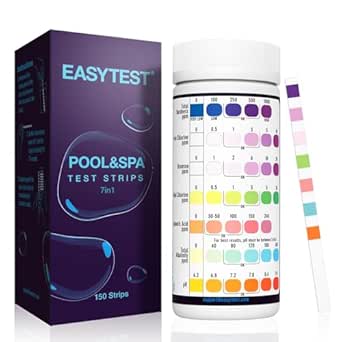 | Best for Quick Strip Checks | Count: 150 test strips | Parameters tested: Bromine, total alkalinity, pH, free chlorine, total hardness, cyanuric acid, total chlorine | Recommended uses: Swimming pools, hot tubs, and spas | VIEW LATEST PRICE | See Our Full Breakdown |
| Taylor K-2006C Complete Pool Water Test Kit |  | Best for Detailed Liquid Testing | Model: K-2006C | Item form: Liquid | Tests for: Free and combined chlorine, bromine, pH, acid and base demand, calcium hardness, total alkalinity, cyanuric acid | VIEW LATEST PRICE | See Our Full Breakdown |
| LUPO 3-in-1 Pool Test Kit for Pools and Spas |  | Best for Basic Chlorine and pH Checks | Tests: Total chlorine, total bromine, and pH | Test capacity: Up to 100 tests | Water compatibility: Freshwater and saltwater | VIEW LATEST PRICE | See Our Full Breakdown |
| Taylor Technologies K-2006-SALT FAS-DPD Saltwater Pool Test Kit |  | Best for Detailed Saltwater Testing | Model: K-2006-SALT | Test method: FAS-DPD high range | Test parameters: Free and combined chlorine, pH, acid and base demand, total alkalinity, calcium hardness, cyanuric acid, and sodium chloride | VIEW LATEST PRICE | See Our Full Breakdown |
| LUPO 6-in-1 Pool and Spa Water Test Kit |  | Best Mid-Range Liquid Kit | Parameters tested: Total chlorine, total bromine, pH, base demand, acid demand, and total alkalinity | Tests included: 100 | Water types: Freshwater and saltwater | VIEW LATEST PRICE | See Our Full Breakdown |
| Bliss Pool 7-in-1 Pool Test Strips with App, 150 Tests |  | Best for App-Guided Strip Testing | Test parameters: Total alkalinity, pH, free chlorine, total chlorine, total hardness, cyanuric acid/stabilizer, and bromine | Strip quantity: 150 | Recommended uses: Indoor and outdoor pools, saltwater pools, and water quality testing | VIEW LATEST PRICE | See Our Full Breakdown |
| Wynvex 7-in-1 Digital Pool and Spa Water Test Kit with 150 Test Strips |  | Best for Numerical Strip Readouts | Model: WN02 | Tests: Total chlorine, free chlorine, bromine, total hardness, cyanuric acid, total alkalinity, and pH | Result time: About 15 seconds | VIEW LATEST PRICE | See Our Full Breakdown |
| pool water test kit | Included components |
|---|---|
| Poolmaster 5-Way Pool and Spa | — |
| WWD POOL Swimming Pool and Spa | — |
| Taylor K-2006 Pool and Spa Wat | Test kit, carrying case, water comparator, water balance calculator, and reagents |
| JNW Direct 7-in-1 Pool and Spa | — |
| Taylor Technologies K-2005 DPD | Comparator, reagents, and storage case |
| Taylor K-1004 DPD 6-in-1 Pool | Comparator, 8 reagents, instructions |
| 7-in-1 Pool and Spa Test Strip | — |
| Taylor Technologies K-1005 DPD | Comparator, storage case, 13 reagents |
| EASYTEST 7-Way Pool Test Strip | — |
| Taylor K-2006C Complete Pool W | Test kit |
| LUPO 3-in-1 Pool Test Kit for | Storage case, waterproof instructions with treatment guides, comparator, OTO reagent, and Phenol Red reagent |
| Taylor Technologies K-2006-SAL | — |
| LUPO 6-in-1 Pool and Spa Water | Storage case, waterproof instructions with treatment guides, comparator, sample tube, OTO, Phenol Red, BD, AD, ALK-10, ALK-20, and ALK-30 reagents |
| Bliss Pool 7-in-1 Pool Test St | — |
| Wynvex 7-in-1 Digital Pool and | Digital reader, 150 test strips, and storage case |
More Details on Our Top Picks
Poolmaster 5-Way Pool and Spa Water Test Kit
The Poolmaster 5-Way covers a practical middle ground: it checks chlorine or bromine, pH, acid demand, and total alkalinity without the broader chemistry panel of the Taylor K-2006. That makes it a sensible fit for owners who want more guidance than a basic chlorine-and-pH kit, but do not need routine calcium-hardness and cyanuric-acid readings. Its clear-view comparator has color chips and embossed markings, while the case keeps the small reagent bottles together between checks. The tradeoff is that results depend on adding the right liquids and interpreting color changes, so this is slower than JNW Direct’s dip-and-read strips. Also, the included Phenol Red is specified for this 5-way kit; substituting a reagent intended for a different kit format can compromise the test.
Pros:- Tests five useful pool and spa chemistry measures
- Comparator includes color chips and embossed markings
- Storage case keeps reagents and tester together
- Suitable for both pools and spas
Cons:- Does not test calcium hardness or cyanuric acid
- Requires careful reagent dosing and color comparison
- Phenol Red must match this 5-way kit format
Best for: Pool and spa owners who prefer liquid tests and want routine chlorine or bromine, pH, acid-demand, and alkalinity checks in one kit.
Not ideal for: Owners who need calcium-hardness and cyanuric-acid readings, or who want the speed of test strips rather than reagent handling.
- Tests:Chlorine, bromine, pH, acid demand, and total alkalinity
- Test method:Liquid reagents and color comparator
- Reagent contents:1 oz. each of Solutions #1, #2, and #3; 1/2 oz. each of Solutions #4 and #5
- Test block:Clear-view acrylic comparator with color chips and embossed markings
- Case material:Polyethylene
- Item weight:15.36 ounces
- Recommended use:Swimming pools and spas
- Warranty:One year against manufacturer defects
Our verdict“Choose this for hands-on routine testing with more coverage than a two-way kit, but skip it if you need a broad chemistry panel.”
WWD POOL Swimming Pool and Spa Chlorine and pH Test Kit
For owners who mainly need to keep an eye on sanitizer and pH, the WWD POOL two-way kit keeps testing straightforward: add four drops of the relevant solution to each sample, then read the clear-view tester. Its integrated scale and color reference make the process more guided than testing with loose strips, and the case gives the two bottles and tester a place to stay together. This is a narrower tool than the Poolmaster 5-Way, which also checks acid demand and alkalinity, and far less informative than the Taylor K-2006. That limitation is also the point: there are fewer results to interpret during a quick routine check. Buyers should track the printed expiration dates on the solutions, and anyone managing water balance beyond chlorine and pH will need another test method.
Pros:- Focuses on the two routine readings many owners check most often
- Clear-view tester has a measuring scale and color reference
- Drop-based process is simple to follow
- Includes two solution bottles, tester, and carrying case
Cons:- Measures only chlorine and pH
- Solutions must be used before their printed expiration dates
- Requires manual drops and color matching
Best for: Pool or spa owners who want a compact liquid kit for frequent chlorine and pH checks and do not need broader water-balance readings.
Not ideal for: Owners troubleshooting alkalinity, hardness, cyanuric acid, or other chemistry issues that this two-test kit does not measure.
- Measures:Chlorine and pH
- pH range:6.0–8.0
- Test method:Add four drops of the appropriate solution to each sample and compare readings
- Included solutions:Chlorine test solution, 1/2 oz.; pH test solution, 1/2 oz.
- Included accessories:Plastic tester and carrying case
- Material:Plastic
- Item weight:132 g
- Recommended uses:Swimming pool and spa
Our verdict“Pick this for uncomplicated chlorine-and-pH checks, but choose the Poolmaster 5-Way or Taylor K-2006 if you need more chemistry readings.”
Taylor K-2006 Pool and Spa Water Test Kit
The Taylor K-2006 earns its place for owners who want more than a quick sanitizer check: its FAS-DPD method distinguishes free from total chlorine, and the kit also covers pH, acid and base demand, alkalinity, calcium hardness, and cyanuric acid. That breadth makes it more useful for diagnosing water-balance questions than the Poolmaster 5-Way or WWD POOL two-way kit. The included color-coded instructions and waterproof chemistry guide add practical support when readings need to inform a treatment decision. The tradeoff is time and technique: this is a manual drop-test kit with sample handling and color interpretation, not a fast strip routine like JNW Direct’s 7-in-1. Its broader panel is valuable for owners who will use those readings; casual testers may find a simpler kit easier to keep up with.
Pros:- Tests a broad range of pool and spa chemistry measures
- FAS-DPD method distinguishes free chlorine from total chlorine
- Includes color-coded instructions and waterproof chemistry reference materials
- Suitable for pools, hot tubs, and spas
Cons:- Manual drop testing takes more steps than test strips
- Requires careful color interpretation and reagent handling
- Broader testing may be unnecessary for owners who only check sanitizer and pH
Best for: Pool, hot-tub, and spa owners who regularly monitor sanitizer and water balance, including free and total chlorine, hardness, and cyanuric acid.
Not ideal for: Casual pool owners seeking a quick, low-effort check or buyers who only need chlorine and pH readings.
- Tests:Free and total chlorine, pH, acid/base demand, total alkalinity, calcium hardness, and cyanuric acid
- Test method:FAS-DPD drop test
- Included components:Test kit, carrying case, water comparator, water balance calculator, and reagents
- Reference materials:Color-coded instructions, treatment guide, and waterproof chemistry guide
- Item weight:2 pounds
- Quantity:1 kit
- Recommended use:Swimming pools, hot tubs, and spas
Our verdict“Choose the K-2006 when detailed, repeatable water-balance readings matter more than testing speed or simplicity.”
JNW Direct 7-in-1 Pool and Spa Test Strips, 100 Pack
JNW Direct suits owners who value a quick check over the control of a multi-step liquid test. Dip a strip for 2 seconds, wait 30 seconds, then compare the pads with the included chart. One strip covers chlorine, bromine, pH, alkalinity, hardness, and cyanuric acid, giving it broader routine coverage than the WWD POOL two-way kit with less setup than the Taylor K-2006. The convenience comes with a different kind of tradeoff: results rely on matching pad colors by eye, so this is less suited to someone who wants the more detailed drop-test process used by Taylor. Storage also matters; moisture and light can affect the strips, and the pack should be used within 90 days of opening. The 100-strip quantity is useful for regular checks, but not if testing is infrequent.
Pros:- One strip checks multiple chemistry factors
- Results are ready after a 30-second wait
- Includes a color chart for reading results
- Suitable for swimming pools and spas
Cons:- Color-pad readings are less suited to buyers who prefer a detailed drop-test process
- Strips must be protected from moisture and light
- Should be used within 90 days of opening
Best for: Pool and spa owners who test often and want several routine chemistry readings without handling multiple liquid reagents.
Not ideal for: Owners who need the control of a detailed drop test or are unlikely to use the strips within 90 days after opening.
- Quantity:100 test strips
- Measurements:Chlorine, bromine, pH, alkalinity, hardness, and cyanuric acid
- Dip time:2 seconds
- Result time:30 seconds
- Reading method:Compare strip colors with the included chart
- Recommended use:Swimming pools and spas
- Material:Test strip paper or plastic
- Use within:90 days of opening
Our verdict“Choose JNW Direct for quick, broad routine checks, but pick the Taylor K-2006 if you want a more detailed liquid-test approach.”
Taylor Technologies K-2005 DPD 9-Way Pool and Spa Water Test Kit
The Taylor K-2005 is the broad-panel alternative for pool and spa owners who want nine listed chemistry measures in a reagent kit. It covers free and total chlorine, total bromine, pH, acid and base demand, total alkalinity, calcium hardness, and cyanuric acid, giving it more scope than the Poolmaster 5-Way and WWD POOL two-way kit. Its 13 reagents, comparator, and illustrated instructions are packed in a storage case, and replacement reagents are available separately. Compared with the Taylor K-2006, this uses a DPD high-range method rather than the K-2006’s FAS-DPD drop test; buyers choosing between them should weigh that method difference alongside their testing needs. The K-2005 still takes sample collection, reagent additions, and color comparison, and its reagents need seasonal replacement.
Pros:- Covers nine listed pool and spa chemistry measures
- Includes 13 reagents, a comparator, and a storage case
- Instructions use plain language and pictograms
- Replacement reagents are available separately
Cons:- Requires collecting samples and adding reagents
- Readings depend on manual color comparison
- Reagents need seasonal replacement
Best for: Pool and spa owners who want a broad reagent-based chemistry panel, including hardness and cyanuric acid, with instructions and storage in one kit.
Not ideal for: Owners who favor quick strip checks, want to avoid replacing seasonal reagents, or specifically want the K-2006’s FAS-DPD testing method.
- Model:K-2005
- Test method:DPD high range
- Test parameters:Free and total chlorine, total bromine, pH, acid and base demand, total alkalinity, calcium hardness, and cyanuric acid
- Reagents:13
- Included components:Comparator, reagents, and storage case
- Instructions:Illustrated instructions with plain language and pictograms
- Weight:2 pounds
- Country of manufacture:USA
Our verdict“Choose the K-2005 for broad DPD-based testing with included guidance, and compare it with the K-2006 if FAS-DPD testing is your priority.”
Taylor K-1004 DPD 6-in-1 Pool and Spa Test Kit
The Taylor K-1004 suits pool owners who want more detail than a basic chlorine-and-pH kit without stepping up to a broader, more involved set. It measures free and total chlorine, bromine, pH, acid demand, and total alkalinity, while the comparator’s molded fill lines help keep sample volumes consistent. Its color-coded instructions and dosage charts also connect a reading to a practical next step. Compared with the Taylor K-1005, it covers fewer parameters and lacks the listed calcium-hardness and cyanuric-acid tests, so it is less suited to a full chemistry check. The tradeoff is a simpler scope: replacement reagents are sold separately, and this still requires collecting a sample and working with liquid reagents rather than dipping a strip.
Pros:- Measures six common pool and spa water parameters
- Comparator has molded fill lines for consistent samples
- Color-coded instructions include dosage charts
- Replacement reagents are available separately
Cons:- Does not list calcium hardness or cyanuric acid testing
- Replacement reagents must be purchased separately
- Requires collecting a sample and adding reagents
Best for: Pool or spa owners who want repeatable chlorine, pH, and alkalinity checks with guidance for routine adjustments.
Not ideal for: Owners who want calcium hardness and cyanuric acid results in the same kit, or who prefer a quick strip test with no reagent handling.
- Tests:Free and total chlorine, bromine, pH, acid demand, total alkalinity
- Test range:Chlorine: 0.5–5 ppm; bromine: 1–10 ppm; pH: 6.8–8.2
- Included components:Comparator, 8 reagents, instructions
- Reagent size:0.75 oz
- Test capacity:100+ tests
- Weight:14.4 oz
- Country of manufacture:USA
Our verdict“Choose the K-1004 for guided routine testing when you want a comparator-based kit but do not need the broader coverage of the Taylor K-1005.”
7-in-1 Pool and Spa Test Strips, 150 Count
For owners who test often and want broad coverage in a single dip, these 150-count 7-in-1 strips offer a straightforward routine. They check total and free chlorine, bromine, hardness, alkalinity, cyanuric acid, and pH, making them more informative than a narrow chlorine-and-pH kit such as the WWD POOL test kit. The process is simple, but it is not instant: dip for two seconds, wait 60 seconds, then match the pads to the chart. That color comparison is less instrument-like than the reagent comparator in the Taylor K-1004, and the result depends on reading the chart carefully. This pack makes sense for regular pool and hot-tub checks, while owners who want a more controlled titration-style result should choose a liquid reagent kit instead.
Pros:- Tests seven water chemistry levels with one strip
- Includes 150 strips for repeated checks
- Works for pools, spas, and hot tubs
- Dip-and-read method is simpler than adding liquid reagents
Cons:- Requires a 60-second wait after dipping
- Results rely on matching pad colors to a chart
- Does not provide the drop-based testing method found in Taylor liquid kits
Best for: Pool and hot-tub owners who test frequently and want seven readings from an easy strip routine.
Not ideal for: Buyers who want rapid results, instrument-style readings, or the more controlled reagent process of a Taylor comparator kit.
- Test coverage:7-way water testing
- Measured levels:Total chlorine, free chlorine, bromine, hardness, alkalinity, cyanuric acid, pH
- Quantity:150 strips
- Reading process:Dip for 2 seconds; read after 60 seconds
- Material:Plastic
- Intended use:Pools, spas, hot tubs, and above-ground or inground pools
- Brand:bestprod
Our verdict“Pick these strips if frequent, broad screening matters more than the controlled sample comparison of the Taylor K-1004.”
Taylor Technologies K-1005 DPD 9-in-1 Pool and Spa Test Kit
The Taylor K-1005 is the step-up choice for owners who want a wider chemistry check than the K-1004 provides, without moving to the larger K-2006C. Its nine listed test parameters include calcium hardness and cyanuric acid alongside chlorine, bromine, pH, demand, and alkalinity readings. The comparator, storage case, 13 reagents, and pictorial instructions make it a more organized bench kit than the EASYTEST strips, though it takes longer because each sample must be collected and treated with reagents. Compared with the K-2006C, the K-1005’s appeal is its defined nine-parameter panel and supplied case; the available product details do not give comparable capacity or test ranges. Reagents also need seasonal replacement, so this is a better fit for owners willing to maintain a liquid-testing kit.
Pros:- Tests nine common pool and spa water parameters
- Includes a comparator, storage case, and 13 reagents
- Pictorial instructions use non-technical language
- Replacement reagents are available separately
Cons:- Testing requires collecting samples and adding reagents
- Reagents need seasonal replacement
- Product details do not specify test capacity or measurement ranges
Best for: Pool owners who want a broad routine chemistry panel, including hardness and cyanuric acid, in a stored-together reagent kit.
Not ideal for: Casual testers who favor a quick strip, or buyers who want stated test ranges and capacity before choosing a kit.
- Model:K-1005
- Test method:DPD
- Test parameters:Free and total chlorine, bromine, pH, acid and base demand, total alkalinity, calcium hardness, cyanuric acid
- Included components:Comparator, storage case, 13 reagents
- Instructions:Pictorial instructions
- Brand:Taylor Technologies
- Country of manufacture:USA
Our verdict“Choose the K-1005 over the K-1004 when calcium hardness and cyanuric acid belong in your regular checks and you accept reagent-based testing.”
EASYTEST 7-Way Pool Test Strips, 150 Count
The EASYTEST strips are geared toward owners who want a broad check without measuring out liquid reagents. Each strip covers seven parameters, including both chlorine measures, bromine, hardness, alkalinity, pH, and cyanuric acid. The short procedure—dip for one second, hold horizontally for 15 seconds, then compare with the bottle chart—is faster than the 60-second wait specified for the other 150-count strips in this roundup. That speed favors frequent spot checks, not lab-style precision: readings still depend on matching pad colors, while the Taylor K-1005 uses a comparator and separate reagents. The 90-day use window after opening also matters; a low-frequency tester may not use the pack within that period. It is a convenient screening option, but not the best fit for someone who wants a longer-lived opened pack or drop-based testing.
Pros:- Tests seven water chemistry parameters at once
- Suitable for pools, hot tubs, and spas
- Provides 150 strips per pack
- Fiber paper strips have no-bleeding pads
Cons:- Opened strips should be used within 90 days
- Results require color comparison with the bottle chart
- Does not offer the comparator-based method of the Taylor K-1005
Best for: Pool, spa, or hot-tub owners who want quick, frequent seven-parameter screening and can use the pack regularly after opening.
Not ideal for: Occasional testers who may keep an opened bottle beyond 90 days, or owners who prefer reagent-based readings over color matching.
- Count:150 test strips
- Parameters tested:Bromine, total alkalinity, pH, free chlorine, total hardness, cyanuric acid, total chlorine
- Recommended uses:Swimming pools, hot tubs, and spas
- Test method:Dip for 1 second; hold horizontally for 15 seconds; compare with bottle chart
- Storage:Store in a cool, dry place; use within 90 days after opening
- Expiration:3 years from manufacture
- Brand:EASYTEST
Our verdict“Choose EASYTEST for fast, repeated strip checks, but favor the Taylor K-1005 if you want a reagent comparator instead of chart matching.”
Taylor K-2006C Complete Pool Water Test Kit
For owners who want a detailed liquid-reagent approach, the Taylor K-2006C covers chlorine, bromine, pH, acid and base demand, calcium hardness, total alkalinity, and cyanuric acid. Its titration drop method gives the process a more controlled structure than reading color pads on the EASYTEST strips, but it asks for more attention: samples must be collected and reagents added by hand. That makes it a stronger match for hands-on pool maintenance than quick everyday screening. Compared with the K-1005, it shares broad chemistry coverage but is described as a complete kit with 2 oz reagent bottles; the listed weight of 3.8 pounds also points to a less portable setup than the compact strip packs. The product details do not specify test capacity, so frequent testers may want that information before choosing.
Pros:- Covers chlorine, bromine, pH, demand, hardness, alkalinity, and cyanuric acid
- Uses a drop-based titration method rather than strip color pads
- Includes 2 oz reagent bottles
- Addresses several key pool chemistry checks in one kit
Cons:- Requires manual sample collection and reagent drops
- Listed weight is 3.8 pounds, making it less convenient to carry
- Product details do not specify test capacity
Best for: Hands-on pool owners who want broad liquid-reagent testing and are comfortable following a drop-based procedure.
Not ideal for: Owners seeking a lightweight, quick screening kit, or buyers who need a stated number of tests per kit before deciding.
- Model:K-2006C
- Item form:Liquid
- Tests for:Free and combined chlorine, bromine, pH, acid and base demand, calcium hardness, total alkalinity, cyanuric acid
- Reagent bottle size:2 oz
- Weight:3.8 pounds
- Included components:Test kit
- Brand:Taylor
Our verdict“Choose the K-2006C if detailed drop-based testing matters more than the speed and portability of the EASYTEST strips.”
LUPO 3-in-1 Pool Test Kit for Pools and Spas
For routine sanitizer and pH checks, this LUPO kit keeps the process simple: add the supplied reagents, compare the sample with the color chart, and read results in seconds. Its 100-test supply and waterproof, four-step instructions make it a practical fit for owners who want a straightforward liquid kit for a pool, spa, or hot tub. It works with freshwater and saltwater, though it does not measure salt concentration.
Compared with the LUPO 6-in-1, this version is easier to keep focused on three readings but leaves out alkalinity and acid/base demand. The Taylor K-2006-SALT covers far more chemistry, including sodium chloride, but calls for a broader testing routine. The tradeoff here is clear: simple readings and a generous stated test capacity, with replacement reagents sold separately and seasonal replacement recommended for accuracy.
Pros:- Checks total chlorine, total bromine, and pH
- Supplies are listed for up to 100 tests
- Color-coded comparator and short instructions make readings approachable
- Suitable for freshwater and saltwater pools, spas, and hot tubs
Cons:- Does not test alkalinity, hardness, cyanuric acid, or salt concentration
- Replacement reagents are sold separately
- Reagents should be replaced each season for maximum accuracy
Best for: Pool and spa owners who mainly need quick checks of chlorine or bromine and pH, and prefer a liquid comparator over test strips.
Not ideal for: Saltwater pool owners who need to measure salt level, or owners who want alkalinity, hardness, or stabilizer readings in the same kit.
- Tests:Total chlorine, total bromine, and pH
- Test capacity:Up to 100 tests
- Water compatibility:Freshwater and saltwater
- Recommended uses:Swimming pools, spas, and hot tubs
- Included components:Storage case, waterproof instructions with treatment guides, comparator, OTO reagent, and Phenol Red reagent
- Result method:Color-coded comparator
- Part number:LP-TK-01-US
Our verdict“Choose this LUPO kit for uncomplicated chlorine-or-bromine and pH monitoring, but choose the LUPO 6-in-1 if you need broader water chemistry checks.”
Taylor Technologies K-2006-SALT FAS-DPD Saltwater Pool Test Kit
Saltwater pool owners who want more than a quick chlorine check get a broad set of readings here: free and combined chlorine, pH, alkalinity, calcium hardness, cyanuric acid, sodium chloride, and acid/base demand. The high-range FAS-DPD method adds a more detailed chlorine measurement than the basic color-comparator approach of the LUPO 3-in-1, while the salt test addresses a parameter that LUPO kit does not cover.
This is the most chemistry-focused pick in this group, but that breadth brings a more involved testing routine. Its 15 small reagent bottles are described as suited to low-frequency testing, so frequent testers may need replacements sooner. Pictogram instructions help make the procedure easier to follow, yet this is not as quick or minimal as the Bliss Pool 7-in-1 strips. Replacement reagents are sold separately, and the kit is most useful when owners will act on its detailed readings.
Pros:- Covers nine listed chemistry measurements, including sodium chloride
- FAS-DPD high-range method tests free and combined chlorine
- Includes comparator, storage case, and pictogram instructions
- Measures parameters beyond the basic LUPO 3-in-1 kit
Cons:- Testing involves more steps than strips or a basic chlorine-and-pH kit
- The 0.75 oz reagent bottles are intended for low-frequency testing
- Replacement reagents are sold separately as supplies run out
Best for: Saltwater pool or spa owners who want to monitor chlorine, salt, stabilizer, alkalinity, and hardness with a liquid-reagent kit.
Not ideal for: Casual testers who want the quickest possible check or only need basic sanitizer and pH readings; the wider test menu requires more steps and attention.
- Model:K-2006-SALT
- Test method:FAS-DPD high range
- Test parameters:Free and combined chlorine, pH, acid and base demand, total alkalinity, calcium hardness, cyanuric acid, and sodium chloride
- Reagents:15
- Reagent bottle size:0.75 oz
- Included equipment:Comparator and storage case
- Origin:Made in the USA
Our verdict“Pick the Taylor K-2006-SALT for detailed saltwater chemistry and chlorine testing, rather than for the fastest routine check.”
LUPO 6-in-1 Pool and Spa Water Test Kit
This six-parameter liquid kit is a useful middle ground for pool and spa owners who want more than sanitizer and pH readings without stepping up to the extensive saltwater testing of the Taylor K-2006-SALT. It covers total chlorine, total bromine, pH, acid demand, base demand, and total alkalinity. Color matching handles several readings, while drop counting supports demand tests, helping owners see what may be needed to adjust water balance.
The package includes supplies for 100 tests, a sample tube, a comparator, a case, and waterproof instructions with treatment guides. Unlike the Bliss Pool 7-in-1 strips, it does not include hardness or cyanuric acid testing, and the liquid-reagent process takes more handling than dipping a strip. It is a more capable choice than LUPO’s 3-in-1 for routine balancing, but replacement reagents are separate and should be replaced each season for maximum accuracy.
Pros:- Tests six parameters, including total alkalinity and acid/base demand
- Includes reagents for up to 100 tests
- Works with freshwater and saltwater systems, pools, spas, and hot tubs
- Uses both color comparison and drop counting with waterproof instructions
Cons:- Does not measure calcium hardness, cyanuric acid, or sodium chloride
- Liquid testing takes more handling than strip-based kits
- Replacement reagents are sold separately and seasonal replacement is recommended
Best for: Pool, spa, and hot-tub owners who want liquid-reagent readings for sanitizer, pH, and alkalinity, plus guidance for acid or base adjustments.
Not ideal for: Owners who need calcium hardness, cyanuric acid, or salt concentration readings, or who prefer a one-step strip test.
- Parameters tested:Total chlorine, total bromine, pH, base demand, acid demand, and total alkalinity
- Tests included:100
- Water types:Freshwater and saltwater
- Suitable for:Swimming pools, spas, and hot tubs
- Result methods:Color comparator and drop counting
- Included components:Storage case, waterproof instructions with treatment guides, comparator, sample tube, OTO, Phenol Red, BD, AD, ALK-10, ALK-20, and ALK-30 reagents
- Model number:LP-TK-04-US
Our verdict“Choose this LUPO when you want a broader liquid kit than the 3-in-1 but do not need the salt and wider chemistry coverage of the Taylor K-2006-SALT.”
Bliss Pool 7-in-1 Pool Test Strips with App, 150 Tests
Bliss Pool pairs a broad strip test with app-based guidance, making it a practical choice for owners who want to check several readings and then enter them for pool-specific product and dosage recommendations. The seven listed parameters include free and total chlorine, bromine, pH, alkalinity, hardness, and cyanuric acid. Compared with the LUPO 6-in-1, this covers hardness and stabilizer and supplies 150 strips, though it gives up the liquid kit’s drop-counting method for acid and base demand.
The app is part of the decision process, not just a bonus: you must enter readings to receive its recommendations. That can help owners who prefer guided next steps, but it adds a phone-based step that the Wynvex digital kit avoids for displaying results. Its stated schedule of twice-weekly testing or checks after pool use may also use strips regularly. Choose it for broad checks and digital guidance, not for owners who want a standalone result without data entry.
Pros:- Checks seven parameters, including free chlorine, hardness, and cyanuric acid
- Includes 150 strips for routine testing
- App offers pool-specific product and dosage recommendations
- Suitable for indoor, outdoor, and saltwater pools
Cons:- App recommendations require users to enter test readings
- Does not provide a digital reader that displays measurements directly
- Frequent suggested testing can use strips at a steady pace
Best for: Pool owners who want strip-based readings across seven parameters and are comfortable entering results in an app for dosage guidance.
Not ideal for: People who prefer a self-contained reader or do not want to use a phone and manually enter test readings to get recommendations.
- Test parameters:Total alkalinity, pH, free chlorine, total chlorine, total hardness, cyanuric acid/stabilizer, and bromine
- Strip quantity:150
- Recommended uses:Indoor and outdoor pools, saltwater pools, and water quality testing
- App:Bliss Pool app with product and dosage recommendations
- Recommended pool pH:7.2–7.8
- Weight:2.8 ounces
Our verdict“Choose Bliss Pool if you want broad strip coverage paired with app guidance, but pick Wynvex if direct numerical display matters more than recommendations.”
Wynvex 7-in-1 Digital Pool and Spa Water Test Kit with 150 Test Strips
Wynvex is the pick for readers who would rather see numerical results than judge strip colors. The digital reader processes a strip and displays results in about 15 seconds, while the kit tests seven listed measures: total and free chlorine, bromine, hardness, cyanuric acid, alkalinity, and pH. Compared with the Bliss Pool 7-in-1, it emphasizes direct readings instead of app-based product and dosage recommendations; buyers who want guidance after testing may prefer Bliss.
The 150 included strips support routine pool and spa checks, and the fitted case keeps the reader and supplies together. That convenience depends on the strips, however: the device cannot perform measurements without them, and the supplied information describes it for pool and spa water rather than a broader range of uses. Unlike the Taylor K-2006-SALT, it does not list a sodium chloride test or a liquid-reagent chlorine method. This is a convenience-focused choice, not a detailed saltwater chemistry kit.
Pros:- Digital reader displays numerical results in about 15 seconds
- Tests seven listed parameters, including free chlorine and cyanuric acid
- Includes 150 test strips for ongoing checks
- Fitted storage case organizes the reader and strips
Cons:- Requires compatible test strips for every measurement
- Does not list a sodium chloride test, unlike the Taylor K-2006-SALT
- Provides no app-based dosage recommendations like the Bliss Pool kit
Best for: Pool and spa owners who want seven strip-based checks displayed as numbers and prefer a reader over visual color-chart matching.
Not ideal for: Saltwater pool owners who need a dedicated sodium chloride measurement, or testers seeking a liquid-reagent method and a wider diagnostic routine.
- Model:WN02
- Tests:Total chlorine, free chlorine, bromine, total hardness, cyanuric acid, total alkalinity, and pH
- Result time:About 15 seconds
- Test strip count:150
- Included components:Digital reader, 150 test strips, and storage case
- Recommended use:Pool and spa water quality testing
- Brand:Wynvex
Our verdict“Choose Wynvex if numerical strip readings are your priority; choose Bliss Pool for app-based treatment guidance or Taylor for dedicated salt testing.”
How We Picked
I compared these kits on the questions that change a pool owner’s day-to-day testing: which water readings they cover, how results are interpreted, how much technique routine use requires, and whether the kit suits pools, spas, or saltwater systems. I also considered practical upkeep, including reagent handling, strip storage, test capacity, and the risk of letting supplies expire before they are used. A larger list of test parameters is useful only when the owner needs those readings and can follow the instructions consistently.
The ranking favors useful coverage and repeatable results without ignoring ease of use. The Taylor K-2006 leads for its detailed chlorine testing and broader analytical approach; dedicated saltwater coverage gives the K-2006-SALT a distinct role. Strips rank well for fast, low-effort checks, while app-connected or digital options add guidance rather than replacing the underlying strip method. Simpler kits place lower when their narrower coverage leaves more blind spots, though they may be a better fit for owners who want only basic checks.
Factors to Consider When Choosing Pool Water Test Kits
Before choosing a kit, decide how you will use its results: routine screening, troubleshooting, or checking a specialized pool setup. The right format is the one you can use correctly and often enough—not automatically the one with the longest parameter list.
Match Test Coverage to Your Pool and Routine
Start with the readings that affect your regular care, then ask whether you also need less frequent checks for your pool system or treatment method. A compact kit can work for a simple maintenance routine, but narrow coverage may leave you reaching for a second test when a problem appears. Broad kits make more sense for owners who will use the extra readings rather than let them go unused. Avoid treating every parameter on a package as equally relevant to every pool. If you are unsure, check your pool equipment and chemical instructions to identify the readings they call for. A kit should cover your real maintenance questions, not just promise the highest count.
Choose Between Strips and Reagent Tests
Strips suit frequent, quick checks because they need little setup, while liquid-reagent kits ask for more steps and careful color or endpoint interpretation. That extra effort can be worthwhile when you want more detailed control or are investigating a persistent imbalance. A common mistake is choosing a more involved kit and then testing less often because the process feels tedious. The opposite mistake is relying on a fast screening result for a decision that needs a closer measurement. Think about who will test the water and how much time they will give each reading. Consistent use of a suitable method is more useful than occasional use of a kit that is too demanding.
Treat Digital Guidance as Assistance, Not a Different Test
App-linked and digital readers can make results easier to interpret, especially for people who find color charts difficult. They still depend on the sample and test medium being handled correctly, so a reader cannot fix a poor sample or a damaged strip. Check how the device pairs readings with the supplied strips and whether you can continue testing if you do not want to use the app. Lighting, timing, and following the instructions can still matter. If you prefer simple manual checks, a digital feature may add steps rather than reduce them. Choose it for the kind of guidance you will use, not the assumption that electronics guarantee greater accuracy.
Account for Pool Type and Sanitizing System
Pool type affects which readings deserve priority, so a saltwater owner should check for salt-specific coverage rather than assume a general pool kit answers every question. Spa owners may also value a kit explicitly designed for pool and spa use, but should verify that its ranges match their care routine. Read the kit’s instructions against the requirements of your sanitizer, equipment, and treatment products. A mismatch can lead to repeated testing with a tool that does not answer the question you are trying to solve. For specialized systems, pair routine checks with the method recommended for that system. This avoids paying for broad coverage that still misses a key need.
Plan for Storage, Reagents, and Test Capacity
Testing supplies are consumables, and their condition affects the usefulness of the result. Keep strips dry and closed, protect reagents from heat and sunlight, and follow the maker’s storage directions. A large strip count can suit a pool tested often, but it can be wasteful if strips expire or degrade before use. Reagent kits also require attention to bottle condition and replacement supplies. Check how many tests you expect to run across the season and whether you can replace the components you use most. The better fit is the kit whose upkeep matches your actual testing pace.
Know When a Screening Result Needs Confirmation
A routine test helps track trends, but unusual readings or persistent water problems may call for a more detailed confirmation. Do not make a major chemical adjustment based on a result you could not interpret confidently. Repeat the test with a fresh sample, follow the instructions closely, and compare the result with the guidance for your pool system. Strips can flag that something has shifted; a more involved reagent test may help clarify the situation. Keep a simple record of readings so you can spot a pattern instead of reacting to one number. This approach can prevent small testing errors from turning into repeated chemical corrections.
Frequently Asked Questions
Should I choose a test-strip kit or a liquid-reagent kit?
Choose strips if you value fast routine checks and will use them regularly, and choose liquid reagents if you are willing to follow more steps for a more detailed testing process. Strips are easy to carry and simple to use, but comparing colors can be subjective and the strips need dry storage. Reagent kits take more care and may require practice, yet their testing method can be better suited to detailed maintenance or troubleshooting. Some owners use strips for routine screening and keep a reagent kit for checks that need more detail. The best match depends on your habits as much as the kit’s features.
Is a 7-in-1 test strip kit enough for maintaining a pool?
A 7-in-1 strip kit can cover several common routine readings and may be enough for basic monitoring when its listed tests match your pool-care needs. It does not automatically replace every specialized or more detailed test a pool system may call for. Check the parameters on the package rather than relying on the number in the product name. If you get an unusual result or struggle to interpret a color, confirm it with a suitable follow-up method before making a major adjustment. Saltwater pool owners should pay particular attention to whether salt testing is included. Use the strip kit as a tool for the questions it actually answers.
Do I need a saltwater-specific pool test kit?
If you own a saltwater pool, a salt-aware kit can cover a need that general pool kits may not address directly. The Taylor K-2006-SALT is the lineup’s dedicated saltwater pick, while general-purpose options may still be useful for other routine readings. Check which readings your salt system’s instructions call for and whether the kit covers them at the ranges you need. Do not assume that a kit labeled for pools automatically includes a salt test. A dedicated option is most useful when you want one kit centered on saltwater maintenance; otherwise, you may prefer a general kit plus a separate salt test.
Are app-connected or digital pool test kits more accurate?
A digital reader can make results easier to interpret, but digital assistance alone does not guarantee a more accurate test. The result still depends on collecting a suitable sample, using an in-date strip, and following the required timing and handling steps. An app may help present or record readings, while the strip remains the source of the test response. If the manual comparison process is already comfortable, digital features may offer convenience more than a different level of testing. Check whether the device works with replacement strips you can readily obtain and whether it fits your preferred testing routine. Treat the result as a measurement to use carefully, not as a substitute for correct technique.
When should I pay more for a detailed test kit?
A detailed kit makes more sense when you test often, want closer control of chlorine levels, or need readings that a basic strip set does not provide. It can also be useful when you are troubleshooting recurring water problems and want more information before adjusting chemicals. If you only need quick routine checks and rarely act on extra parameters, a simpler kit may be easier to maintain and use consistently. Factor in the extra time, instruction-following, and reagent upkeep required by a more involved kit. Paying for greater coverage is worthwhile only when you will use that coverage and understand how to interpret it.
Conclusion
For most owners who want detailed, versatile testing, I recommend the Taylor K-2006 as best overall; the Taylor K-2006C is the premium choice for buyers who want the complete-kit format. For best value and quick routine checks, the JNW Direct 7-in-1 strips offer broad everyday coverage without the steps of a reagent kit. Beginners who want a simple approach can start with a multi-parameter strip option such as EASYTEST 7-Way, while anyone who prefers guided interpretation can compare the Bliss Pool app and Wynvex digital reader. For saltwater pools, the Taylor K-2006-SALT is the specific pick; for a narrower, straightforward check, the LUPO 3-in-1 has a clearer role than a more involved kit. Choose by the readings you need and the method you will use consistently.