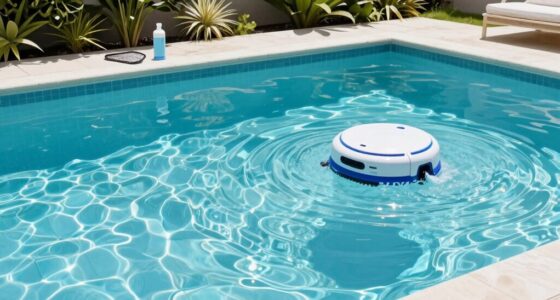
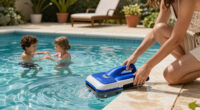
Choosing an automatic pool cleaner is mainly a choice between paying more for an independent machine and paying less for a cleaner that uses equipment you already own. Robotic pool cleaners have their own motor and filter, so they can collect debris without sending it through the pool’s main filtration system. Suction-side cleaners connect to a suction port or skimmer and rely on the pool pump to move and capture debris. That difference affects setup, running costs, coverage, and how much extra work the pool system must do. A robot suits owners who want more self-contained cleaning and can justify the purchase price; a suction cleaner is a practical fit when keeping the initial outlay low matters most and the pump system is compatible.

Get pool and patio gear delivered free with Prime
- Fast, free delivery on millions of items
- Prime Video, Amazon Music and more included
- Member-only deals all year

WYBOT C1 Cordless Robotic Pool Vacuum for Inground Pools
- ✔ Pool type: Inground
- ✔ Coverage: Floor, walls, waterline, and steps
- ✔ Maximum pool area: 1,618 sq. ft.

Dolphin Nautilus CC Plus Robotic Pool Cleaner
- ✔ Pool type: In-ground
- ✔ Maximum pool length: 40 ft
- ✔ Cleaning time: About 2 hours

Dolphin Nautilus CC Automatic Robotic Pool Vacuum Cleaner
- ✔ Pool type / limit: In-ground / up to 33 ft
- ✔ Cycle time: About 2 hours
- ✔ Power source: Corded electric, 230 V
At a Glance
| Criteria | Robotic pool cleaners | Suction-side pool cleaners | Winner |
|---|---|---|---|
| Purchase cost | Usually higher | Usually lower | B |
| Running costs | Uses electricity; does not require the pool pump to run for cleaning | Uses the pool pump, which may need to run during cleaning | Depends |
| Cleaning coverage | Many models clean the floor and may also cover walls and the waterline; coverage varies by model and pool | Often suited to floors; wall and waterline cleaning depend on the model and pool | A |
| Debris handling | Captures debris in its own basket or filter | Sends debris through the pool’s filter system or a compatible inline filter | A |
| Pool-system dependence | Operates separately from the pool’s filtration system | Requires a compatible suction port or skimmer and adequate pump flow | A |
| Setup and scheduling | Connect, place in the pool, and run; features vary by model | Connect hoses and set suction or flow as directed; scheduling depends on the pool system | A |
| Maintenance | Empty and rinse its filter; inspect brushes, tracks, and cable as applicable | Check hoses and cleaner parts, and clean the pool filter more often as needed | Depends |
WYBOT C1 Cordless Robotic Pool Vacuum for Inground Pools
The WYBOT C1 stands out for buyers who want one cleaner to handle more than the pool floor. Its stated coverage includes floors, walls, waterlines, and steps, giving it a broader surface brief than either Dolphin in this lineup, whose descriptions emphasize wall climbing and surface scrubbing. A 180 μm filter and 3-liter capacity provide useful context for upkeep: we can see the filtration rating and basket volume, though how often it needs attention will depend on debris and pool conditions.Its cordless design changes the routine. With up to 160 minutes per charge and app controls for scheduling and modes, it avoids managing a power cord through the pool and allows cleaning to be configured from the app. Gyroscope-guided N-Path and S-Path patterns are intended to organize its route, while the listed 45° maximum slope indicates a stated climbing capability. The tradeoff is charging: a full charge takes about four hours, so it is not a quick turnaround option after a depleted cycle. It is also specifically designed for inground pools, and its maximum area and depth limits matter when matching it to a larger or deeper pool. Compared with the Nautilus CC Plus, it offers cordless convenience and more explicitly named surfaces, but the Dolphin’s two-hour cleaning cycle and simple plug-in setup may suit buyers who prefer a familiar routine.
Pros:
- Cleans floors, walls, waterlines, and steps.
- Cordless operation avoids managing a cable in the pool.
- App controls support scheduling and selectable modes.
- Up to 160 minutes of runtime with gyroscope-guided paths.
Cons:
- A full charge takes about four hours.
- Designed for inground pools, with listed area and depth limits.
- The 3-liter capacity may require attention depending on debris load.
Best for: Inground-pool owners who want cordless operation, app scheduling, and stated cleaning coverage that includes steps and the waterline.
Not ideal for: Owners of above-ground pools, pools exceeding the listed area or depth limits, or anyone who needs to run consecutive cycles without a multi-hour recharge.
Bottom line: Choose the WYBOT C1 when cordless control and broader specified surface coverage matter more than fast recharging.
“Choose the WYBOT C1 when cordless control and broader specified surface coverage matter more than fast recharging.”
Dolphin Nautilus CC Plus Robotic Pool Cleaner
The Dolphin Nautilus CC Plus is the plug-and-play pick for owners who want a defined cleaning cycle without app-based configuration. It is specified for in-ground pools up to 40 feet long and takes about two hours per cycle. That makes its pool-length limit the broadest explicitly stated among the three options: the Nautilus CC is listed for pools up to 33 feet, while the WYBOT uses maximum pool area and depth figures instead of a length limit.The Plus climbs walls and scrubs pool surfaces with an active brush, but its description does not explicitly promise waterline or step cleaning as the WYBOT does. Its most practical maintenance feature is the top-load filter basket, which can be accessed from above rather than requiring a more involved disassembly. That convenience does not eliminate regular filter cleaning; the supplied guidance also calls for dry storage when it is not in use. Unlike the C1, the Dolphin is corded and offers no stated app scheduling or battery runtime. Choose it over the Nautilus CC when the 40-foot pool limit is useful and uncomplicated operation is your priority. Skip it if your key requirement is cable-free cleaning or explicitly listed coverage of steps and the waterline.
Pros:
- Stated for in-ground pools up to 40 feet long.
- Completes a cleaning cycle in about two hours.
- Climbs walls and uses an active scrubbing brush.
- Top-load basket makes filter access convenient.
Cons:
- Requires a power connection and dry storage between uses.
- Filter basket needs regular cleaning.
- The supplied description does not specify step or waterline coverage.
Best for: Owners of in-ground pools up to 40 feet who want a simple plug-and-play cleaner with an easy-access filter basket.
Not ideal for: Buyers who need cordless operation, app controls, or explicitly specified waterline and step cleaning.
Bottom line: The Nautilus CC Plus is a strong fit for a larger in-ground pool when simple setup and easy filter access outweigh cordless flexibility.
“The Nautilus CC Plus is a strong fit for a larger in-ground pool when simple setup and easy filter access outweigh cordless flexibility.”
Dolphin Nautilus CC Automatic Robotic Pool Vacuum Cleaner
The Dolphin Nautilus CC shares the basic appeal of the CC Plus: connect the power supply, start a cycle, and let the cleaner climb walls and scrub pool surfaces. Its roughly two-hour cycle and top-load filter basket make the maintenance routine easy to understand. The meaningful difference is pool fit. This model is listed for pools up to 33 feet, compared with 40 feet for the CC Plus, so we would favor the Plus when a longer pool is within the budget of your space or requirements.Against the WYBOT C1, the Nautilus CC gives up cordless operation, app controls, and explicitly stated coverage of the waterline and steps. In return, it has a simple corded setup and a clear role for a pool within its stated size limit. The description says it climbs walls and uses an active brush, but it does not provide the C1’s runtime, filtration rating, or navigation-path details. Its plastic construction also calls for protection from harsh chemicals and temperature extremes, and the listed one-year limited warranty is useful to check against your ownership expectations. This is the sensible straightforward choice when the pool is no more than 33 feet long and advanced controls are unnecessary; a longer pool points us toward the CC Plus instead.
Pros:
- Plug-and-play operation with a cycle of about two hours.
- Wall-climbing design and active scrubbing brush.
- Top-load filter basket is easy to reach for debris removal.
- A straightforward option for pools within the 33-foot limit.
Cons:
- Requires a power source and is not battery-operated.
- Pool length is limited to 33 feet.
- Plastic components need protection from harsh chemicals and extreme temperatures.
Best for: Owners of in-ground pools up to 33 feet who want wall climbing, active scrubbing, and a basic plug-and-play cycle.
Not ideal for: Owners of longer pools, anyone seeking cordless convenience, or buyers who want listed app controls and detailed navigation specifications.
Bottom line: Pick the Nautilus CC for a smaller in-ground pool and uncomplicated corded cleaning; move to the CC Plus for a longer pool.
“Pick the Nautilus CC for a smaller in-ground pool and uncomplicated corded cleaning; move to the CC Plus for a longer pool.”
As an Amazon Associate we earn from qualifying purchases.
Key Differences
The biggest practical difference is where the cleaning work happens. A robotic cleaner has its own motor and debris filter, so it can collect dirt without routing it through the pool pump. A suction cleaner uses the pump and filtration system, which usually keeps the cleaner’s purchase price lower but ties cleaning to that equipment. If the pump already runs long enough for filtration, a suction cleaner may fit naturally into the routine. If cleaning would require extra pump time, the apparent savings can narrow.
Robots often offer broader coverage and more control, but features vary substantially by model: some clean only the floor, while others climb walls or scrub the waterline. Suction cleaners also differ, and many focus on floor cleaning. Neither category guarantees a spotless pool without matching the cleaner to the pool’s shape, surface, debris, and plumbing. Robots are the stronger choice for owners who value independent operation and debris capture; suction models make more sense when price is the priority and the filtration setup can support them.
Detailed Comparison
Purchase cost (Suction-side pool cleaners wins — moderate)
Suction cleaners usually win on the initial purchase price, making them easier to fit into a tight budget. Robots typically cost more because they include their own drive and filtration components. This is a moderate difference at purchase, but the lower sticker price alone does not determine long-term value: pump run time and maintenance matter too.
Running costs (moderate difference)
Robots use electricity, while suction cleaners draw on the pool pump, so the winner depends on local energy costs and how the pool is already operated. If the pump would run anyway, suction cleaning may add little incremental energy use. If it needs extra run time for cleaning, the robot may cost less to operate. This gap is moderate and should be judged against the pool’s actual schedule and equipment.
Cleaning coverage (Robotic pool cleaners wins — moderate)
Robots have the edge because many models can clean more than the pool floor, including walls and sometimes the waterline. Those capabilities are model-specific, so check the exact coverage rather than assuming every robot does it. Many suction cleaners focus on the floor, though some models offer broader coverage. The difference is moderate: it matters most if walls or the waterline are recurring problem areas.
Debris handling (Robotic pool cleaners wins — moderate)
Robots capture debris in their own filter, reducing the load sent to the pool’s main filter. Suction cleaners route debris through the filtration system or an inline filter, so leaves and fine material can mean more filter cleaning. This is a moderate advantage for robots if the pool collects heavy debris or the owner wants the cleaner’s waste separated from ordinary circulation.
Pool-system dependence (Robotic pool cleaners wins — major)
A robot operates independently of the pool pump and suction plumbing, which gives it a major practical advantage when pump scheduling or suction compatibility is a concern. A suction cleaner needs an appropriate connection and enough flow to work well. For a compatible pool with a reliable pump schedule, that dependency may be unremarkable; for other setups, it can limit convenience or rule out the cleaner entirely.
Setup and scheduling (Robotic pool cleaners wins — minor)
Robots are generally easier to run as a separate cleaning task: place the unit in the pool, connect it as directed, and start a cycle. Suction cleaners require a hose connection and settings suited to the pool’s suction system. Both can be straightforward after initial setup, but robots win by a minor margin when owners want cleaning to happen independently of the pump routine.
Maintenance (minor difference)
Neither type is maintenance-free. Robot owners empty and rinse a separate filter and check moving parts; suction-cleaner owners inspect hoses and cleaner parts and may need to clean the pool filter more often. The work differs more than it disappears, so there is no category-wide winner. The right choice depends on whether handling a small dedicated filter or adding debris to the pool system is less inconvenient.
Robotic pool cleaners: Pros and Cons
Pros:
- Cleans independently of the pool pump and suction plumbing
- Captures debris in its own filter
- Many models offer floor, wall, or waterline coverage
Cons:
- Usually costs more upfront
- Requires regular filter and moving-part checks
- Coverage and features vary by model
Suction-side pool cleaners: Pros and Cons
Pros:
- Usually costs less to buy
- Can work well with a compatible pump and suction setup
- Avoids adding a separate powered machine to the pool routine
Cons:
- Depends on pump flow and compatible plumbing
- May add debris to the pool’s filtration system
- Often offers less coverage than feature-rich robotic models
Who Should Choose What
Choose Robotic pool cleaners if:
- You want cleaning to run independently of the pool pump.
- Your pool collects substantial debris and you prefer to capture it separately.
- You want wall or waterline cleaning and have confirmed the chosen model covers those areas.
- You value convenience enough to pay more upfront.
Choose Suction-side pool cleaners if:
- Your main priority is a lower purchase price.
- Your pool has a compatible suction connection and adequate pump flow.
- The pump already runs on a schedule that can accommodate cleaning.
- Floor cleaning meets your needs and you are comfortable maintaining the pool filter.
Skip both if: Skip both until you check compatibility if your pool has unusual plumbing, a shape or surface the models do not support, or debris that requires a different cleaning approach.
Value for Money
Suction cleaners are usually the better value for buyers focused on the lowest upfront cost, especially when the pump already runs long enough and the pool’s filter can handle the debris. In that situation, paying more for a robot may buy convenience or broader coverage that the owner does not need. A robot earns its higher price for owners who want cleaning independent of pump operation, want a separate debris filter, or need coverage that a suitable suction model does not provide. Compare the specific model’s coverage and the pool’s likely pump schedule before deciding: a higher purchase price is worthwhile only when those practical differences solve a real problem.
Final Verdict
For most owners who can afford the higher purchase price and want flexible, self-contained cleaning, a robotic cleaner is the stronger choice. It avoids dependence on the suction system and keeps captured debris out of the pool’s main filter. Choose a suction-side cleaner if low initial cost is the deciding factor, your plumbing and pump are compatible, and floor cleaning is enough. The key deciding factor is whether independent operation and separate debris capture are worth paying more for; if they are not, the suction cleaner is the sensible buy.
Frequently Asked Questions
Are robotic pool cleaners worth the higher price?
They can be worth it if independent cleaning, a separate debris filter, or broader coverage saves effort or solves a recurring pool-cleaning problem. If the pump already runs for suitable cleaning time and a suction model covers what you need, the extra cost may not pay off.
Can a suction-side cleaner replace a robotic cleaner?
For routine floor cleaning in a compatible pool, often yes. It may not match a robot’s independence or the coverage offered by some robot models, and it sends debris through the pool’s filtration system unless an inline filter is used.
Which type is better for leaves and larger debris?
A robot with a suitable large-debris basket can collect leaves separately. A suction cleaner may also handle larger debris if designed for it, but the material can reach the pool filter. Check the specific model’s debris capacity and any need for an inline leaf canister.
Does a robotic cleaner reduce pool pump run time?
It can clean without relying on the pump, so owners may be able to schedule cleaning separately. The pump still has to run as needed for circulation and water treatment; a cleaner does not replace those functions.
Fall Picks

eufy Security Essential 7-Piece Alarm System with HomeBase Mini
As an affiliate, we earn on qualifying purchases.