TL;DR
A Planet Natural report says winter tree watering should be based on soil moisture, not a fixed gallon amount or weekly schedule. Check the root zone and water slowly only when soil is dry and unfrozen; newly planted trees and evergreens may need closer monitoring.
Planet Natural has published guidance for watering trees during dry fall and winter conditions, advising people to check moisture in the root zone rather than follow a fixed schedule. The recommendation matters because tree age, root spread, soil, rainfall, snow cover and frozen ground all affect whether additional water can help or instead leave soil saturated.

Get pool and patio gear delivered free with Prime
- Fast, free delivery on millions of items
- Prime Video, Amazon Music and more included
- Member-only deals all year
The report recommends testing soil at several points with a screwdriver, soil probe or narrow trowel. Dry, crumbly soil several inches below the surface may indicate a need to water, while cool, moist soil does not. Surface appearance can be misleading: a dry crust may cover wet, poorly aerated soil, particularly in clay. The report advises skipping supplemental watering when the ground is frozen or saturated, when persistent snow is supplying moisture, or when a hard freeze is imminent.
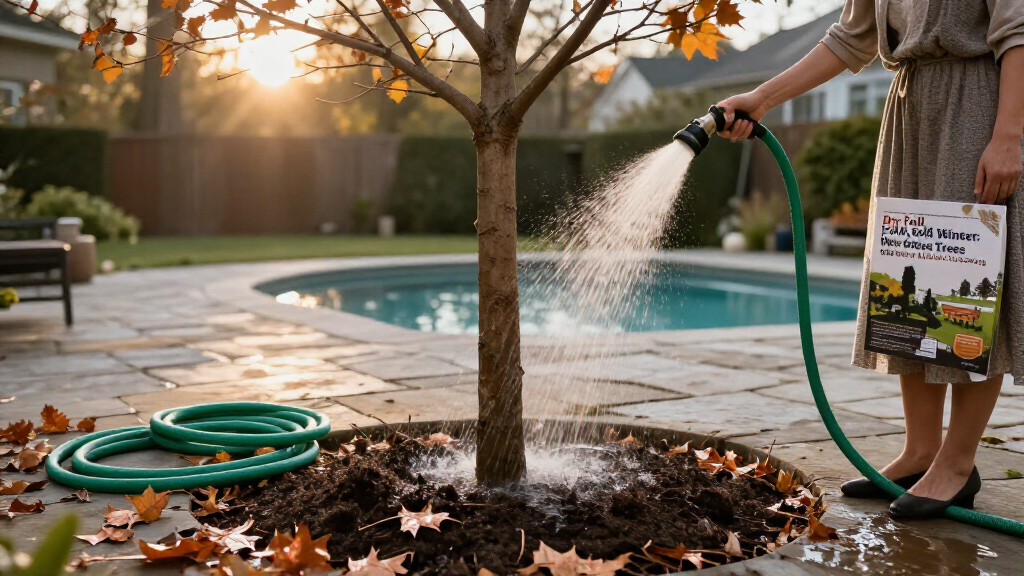
For a newly planted tree, check both the original root ball and the soil around it. Water slowly across the planting area and a little beyond it, then keep checking through a dry late fall. Stop once the ground freezes. The report also advises spreading a 2-to-4-inch layer of mulch over the root zone while keeping it clear of the trunk flare; mulch should not be piled against bark.
For established shade trees, the watering target is the broad root zone, particularly toward the dripline, rather than the trunk base. A soaker hose, low-flow sprinkler or soft spray can deliver water gradually. If water runs off, pause; later, check whether it reached the intended depth. Avoid repeated shallow watering and concentrated deep-root injections, the report says.
Watering Depends on Root-Zone Conditions
The guidance addresses a common winter-care uncertainty: a dry-looking surface does not establish that tree roots need water. Watering by calendar alone can miss local differences in soil, recent precipitation and drainage. Checking below the surface can help avoid both leaving a genuinely dry root zone untreated and adding water where soil is already saturated or frozen.
The stakes differ by tree. Newly planted trees have limited roots and may not draw enough moisture from surrounding soil if the original root ball dries out. Evergreens can lose water through needles during winter while frozen or dry soil limits replacement. Meanwhile, watering an established tree only at its trunk can miss much of the area where its roots spread. The report’s approach is conditional: water only when a tree’s root zone is dry, unfrozen and able to take in moisture.
Products Worth Considering

Dyson Ball Animal 3 Upright Corded Vacuum

Philips Hue Bridge Pro Smart Lighting Hub, 1-Pack

Levoit Vital 100S-P Air Purifier with Washable Pre-Filter
As an affiliate, we earn on qualifying purchases.
Different Trees Need Different Checks
The Planet Natural report does not set a universal quantity of water or interval between watering. It says the decision varies with tree size and age, root depth, soil texture, snow cover and recent rain. Established shade trees generally have a wider root system than newly planted ones, while many ornamental trees and shrubs have substantial roots near the surface. The report names birches, maples, dogwoods and lindens among plants that may need attention during extended dry periods.
In dry cold regions, the report says a mild midday period with air and soil above 40°F and no snow cover may be suitable for slow watering. That is a conditional guideline, not a requirement to water whenever temperatures rise above that level. In places with regular fall rain and winter snow, observation may be more useful than adding water. The report also cautions that wind protection and mulch can reduce stress but do not replace moisture when the root zone is dry.
Local Conditions Set the Answer
The report provides general care guidance, not a site-specific watering prescription. It does not identify a single volume, duration or schedule that applies to every tree; those details depend on the soil, root zone and weather at each site. Its guidance also does not establish that any particular tree is currently stressed or needs watering.
It remains necessary to check conditions locally, including moisture at more than one point around a mature tree when soil, slope or irrigation may vary. The source does not provide a location-specific forecast or current soil readings. People should treat the temperature and timing advice as conditional and avoid watering if ground is frozen, saturated or facing an imminent hard freeze.
Check Soil Before Adding Water
The next step for gardeners and property owners is to inspect the root zone rather than rely on the date or the appearance of the surface. Check several locations, including the original root ball for a new tree and areas toward the dripline for a mature one. If the soil is dry and unfrozen, apply water slowly, pause if runoff begins, and recheck whether moisture reached the intended depth.
Continue monitoring during extended dry, snow-free periods, with extra attention to newly planted trees, shallow-rooted ornamentals and evergreens. Stop when the ground freezes, and reassess after rain or snow changes soil conditions. The report’s central advice is to make each watering decision in response to observed root-zone moisture, not a routine schedule.
Key Questions
How can I tell if a tree needs water in winter?
Use a screwdriver, probe or narrow trowel to check soil several inches below the surface in multiple places. Dry, crumbly soil may indicate a need; cool, moist soil does not. Do not rely on a dry surface crust alone.
When should I avoid watering trees?
The report advises against supplemental watering when soil is frozen or saturated, when persistent snow is supplying moisture, or when a hard freeze is imminent.
Where should I water a mature shade tree?
Apply water over the broad root zone, especially toward the dripline, rather than concentrating it at the trunk. Use a slow application and check for runoff.
Do evergreens need winter watering?
They may need attention during dry, snow-free periods because needles can lose water while dry or frozen soil limits replacement. Check that the root zone is dry and unfrozen before watering; spraying foliage is not a substitute.
Source: rss