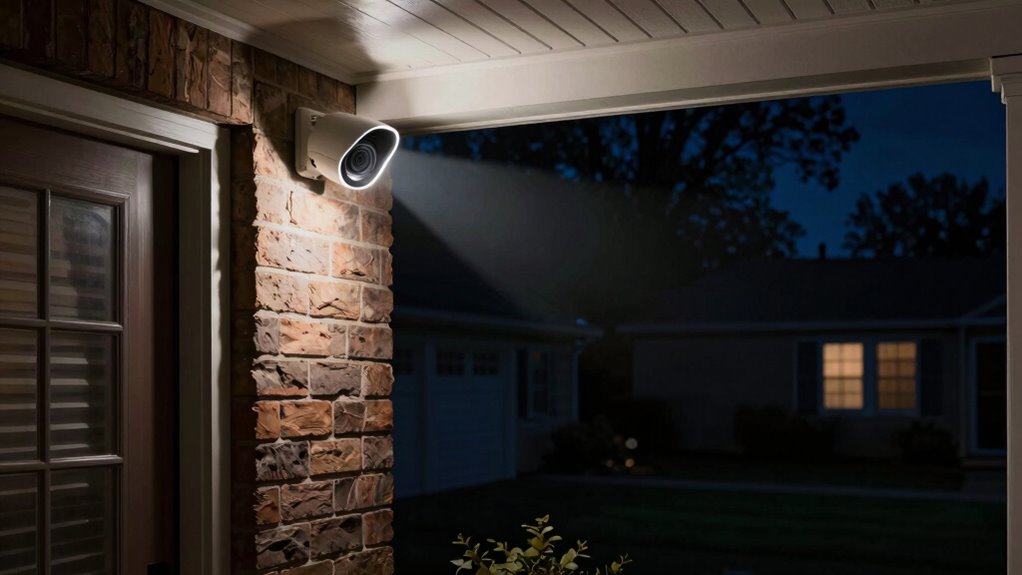

To catch motion at night, you should adjust your outdoor security camera’s sensitivity settings gradually, ensuring it detects genuine activity without triggering false alarms from shadows or weather. Position the camera carefully to cover key spots, and use motion zones to focus on important areas. Regularly test and fine-tune these settings, and avoid common mistakes like poor placement or bad lighting. Keep in mind that proper configuration makes a big difference—learn more to optimize your setup.

Get pool and patio gear delivered free with Prime
- Fast, free delivery on millions of items
- Prime Video, Amazon Music and more included
- Member-only deals all year
Key Takeaways
- Use infrared (IR) sensors to detect heat signatures and see clearly in low-light or no-light conditions.
- Adjust sensitivity settings gradually to balance detecting real motion and avoiding false alarms from environmental factors.
- Properly position cameras at strategic angles and heights to maximize coverage of entry points and high-traffic areas.
- Define and fine-tune motion zones to focus detection on critical areas, reducing false triggers from shadows or reflections.
- Regularly review system logs and test camera performance to optimize settings based on changing lighting and environmental conditions.
outdoor security camera with night vision
As an affiliate, we earn on qualifying purchases.
As an affiliate, we earn on qualifying purchases.
How Do Outdoor Security Cameras Detect Motion at Night?
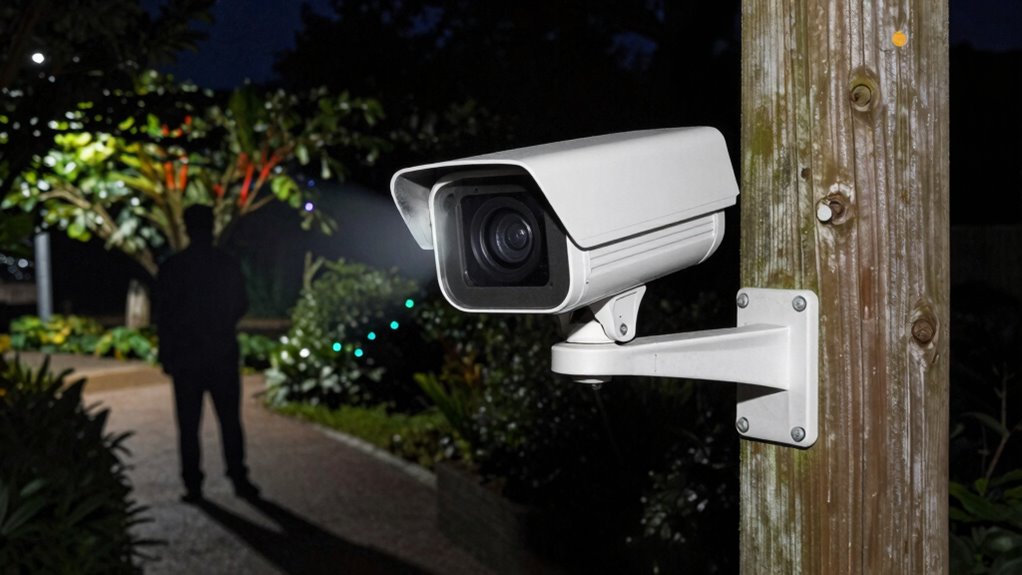
Have you ever wondered how outdoor security cameras can detect motion in complete darkness? It all comes down to their advanced sensors and how they interpret changes in lighting conditions. Infrared (IR) sensors play a vital role, allowing cameras to see in low-light or no-light situations by detecting heat signatures or reflected IR light. Proper camera placement is essential; positioning cameras at strategic angles minimizes blind spots and guarantees they capture the right area. When lighting conditions fluctuate—like shadows or passing headlights—the camera’s motion detection adjusts accordingly. Many cameras also use algorithms to distinguish between actual movement and minor changes caused by weather or lighting. This combination of sensor technology and thoughtful placement helps your outdoor camera reliably catch movement at night.
How to Adjust Sensitivity Settings to Minimize False Alarms?
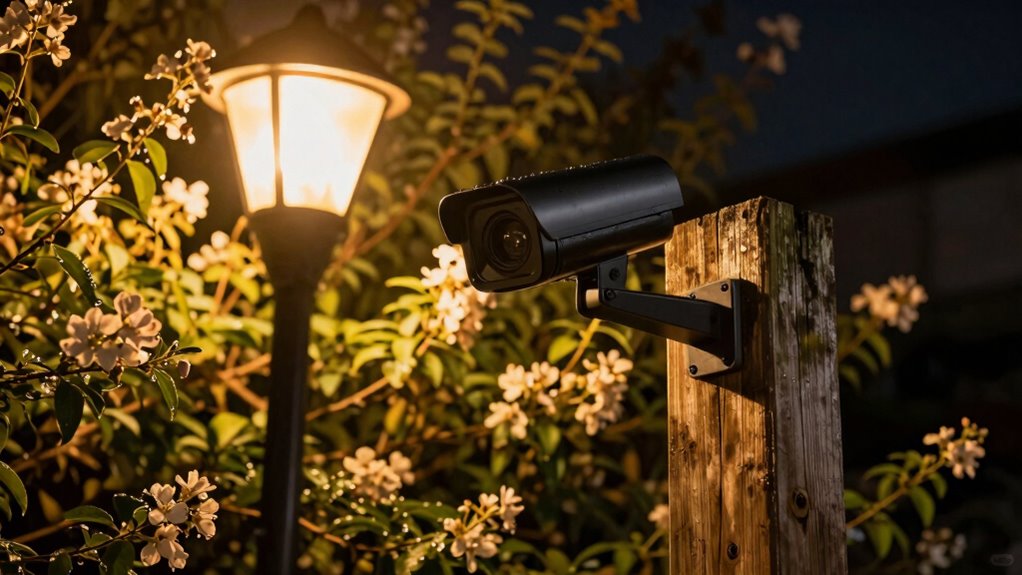
Adjusting the sensitivity settings on your outdoor security camera is essential for reducing false alarms caused by environmental factors like wind, passing cars, or moving shadows. Proper sensitivity calibration allows your camera to detect genuine motion while ignoring minor disturbances. Start by lowering the sensitivity gradually, testing how it reacts to typical outdoor activity. If you notice frequent false alarms, continue decreasing sensitivity until only meaningful motion triggers alerts. Conversely, if your camera misses important events, increase sensitivity slightly. Keep in mind that ideal sensitivity varies based on your environment. Regularly review your camera’s detection performance and adjust accordingly. This fine-tuning process helps with false alarm reduction, ensuring your security system responds accurately without unnecessary alerts. Proper sensitivity calibration is key to maintaining reliable, hassle-free outdoor surveillance. Understanding motion detection settings can further enhance your ability to customize alerts effectively, especially when considering environmental factors that influence detection accuracy. Additionally, utilizing adjustable sensitivity features allows for more precise control tailored to your specific outdoor conditions. Regularly monitoring your camera’s performance and making incremental adjustments can also improve overall alarm accuracy, preventing both missed detections and false positives. To optimize detection, consider testing different sensitivity levels in various weather conditions to find the best setting for your environment.
How to Focus Your Camera’s Detection With Motion Zones?
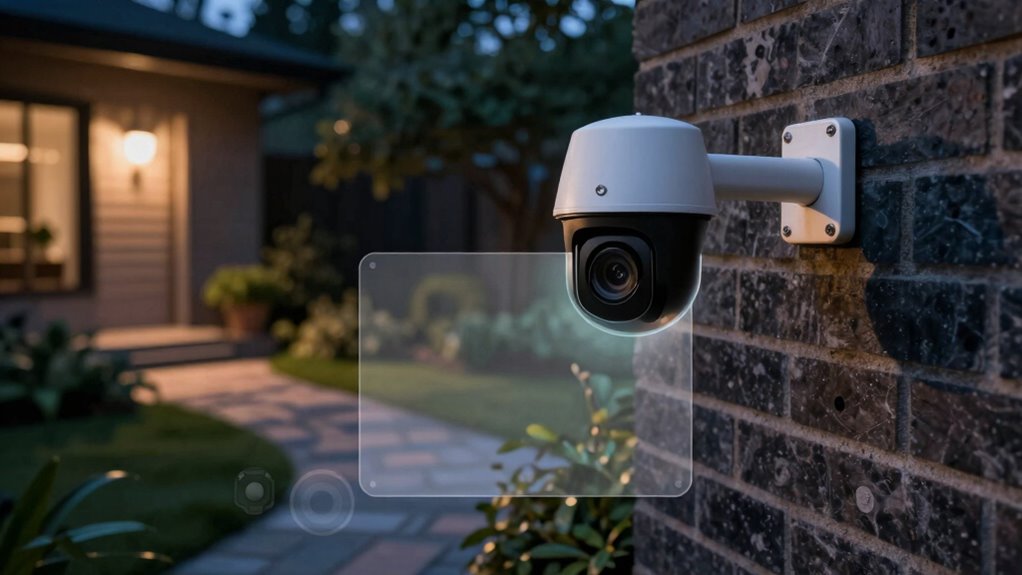
To get the most out of your outdoor camera, you need to define critical detection areas using motion zones. Adjust the zone sensitivity levels to prevent false alarms and make certain important movements are captured. Fine-tuning your motion detection settings helps you focus on what truly matters without missing key activity. Paying attention to contrast ratio can also enhance nighttime image clarity, ensuring that motion detection remains accurate even in low-light conditions. Additionally, understanding creative craft ideas can inspire you to customize your camera setup with DIY accessories for better coverage. Proper camera placement and understanding solar system safety principles can further improve overall security and reliability. Incorporating ethical considerations into your setup can also foster trust and ensure responsible monitoring practices, especially when considering digital content exploration to enhance user engagement.
Defining Critical Detection Areas
Focusing your camera’s detection with motion zones allows you to monitor the most important areas effectively while reducing false alerts. To do this, identify critical zones based on your property’s layout and activity patterns. Consider lighting conditions; well-lit areas are easier to monitor, while poorly lit zones may require additional lighting or adjustments. Proper camera placement is essential—position your camera to cover entry points and high-traffic areas without unnecessary backgrounds. When defining these zones, keep in mind:
- Highlight areas where movement indicates a security concern
- Avoid zones with frequent false triggers like trees or moving shadows
- Use multiple zones to prioritize key regions
This targeted approach ensures your camera focuses on what matters most, improving detection accuracy at night.
Adjusting Zone Sensitivity Levels
Fine-tuning your zone sensitivity levels allows you to better control how your camera detects movement within designated areas. Adjusting zone sensitivity helps you focus on genuine activity while reducing false alarms caused by small animals or environmental changes. Typically, higher sensitivity detects even minor motion, while lower sensitivity filters out less significant movement. Use your camera’s settings to set different sensitivity levels for each zone, depending on the area’s importance. Additionally, understanding motion detection settings can help you identify potential cybersecurity vulnerabilities related to device configuration, ensuring your system responds accurately to real threats without unnecessary alerts. Incorporating knowledge of water-related environments can also be useful, especially if your security cameras are installed near pools or water features, to prevent false triggers caused by reflections or movement on water surfaces. Properly configuring motion zones can significantly improve your camera’s effectiveness and reduce unnecessary notifications, while awareness of zone sensitivity adjustments helps optimize detection accuracy.
Fine-Tuning Motion Detection Settings
Adjusting your camera’s motion detection settings helps you target specific areas more accurately. By fine-tuning motion zones, you can avoid false alerts caused by lighting conditions or unwanted movement. Focus on proper camera placement to maximize effectiveness, ensuring the zones cover high-traffic areas while excluding irrelevant spots. Use these tips to refine your settings:
- Adjust zones to match lighting conditions, preventing shadows or reflections from triggering alerts.
- Limit detection areas to key spots, reducing false alarms from nearby moving objects.
- Test and modify zones regularly as your environment changes or as lighting conditions shift at night.
- Consider the Free Floating landscape to position cameras in areas less prone to unwanted movement, enhancing detection accuracy.
This approach ensures your camera detects genuine motion, saves storage, and enhances security coverage. Properly setting motion zones makes nighttime surveillance more reliable and focused.
How to Set Detection Range and Alarm Timing for Better Night Monitoring?
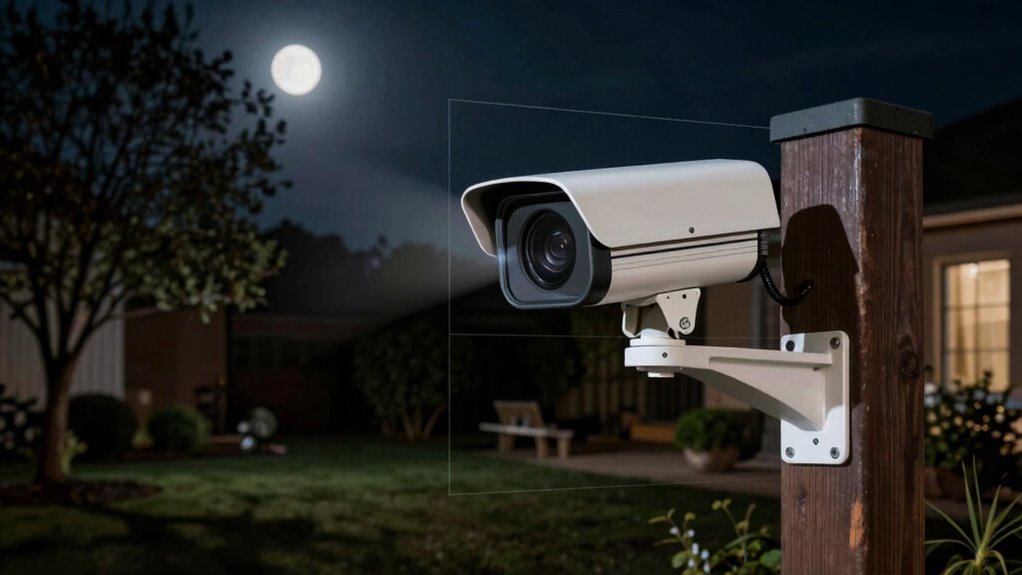
To guarantee your outdoor security cameras effectively monitor your property at night, you need to set the detection range and alarm timing carefully. Start by adjusting the detection range based on your lighting conditions; in darker areas, extend the range to catch motion earlier. Proper camera placement is essential—position cameras where they won’t be obstructed and where lighting is sufficient to minimize false alarms. Set alarm timing to match activity patterns; for example, increase sensitivity during active hours and reduce it overnight if false triggers occur. Keep in mind that overly broad detection ranges may cause unnecessary alerts, while too narrow ranges could miss important motion. Fine-tuning these settings ensures better night monitoring, giving you timely alerts without overwhelming notifications. Additionally, understanding the detection zone capabilities of your cameras can help optimize coverage and reduce false alarms. Adjusting cabling connections properly can also prevent false alarms caused by wiring issues or interference, ensuring more reliable detection. Properly configuring the detection sensitivity settings can further enhance accuracy and reduce false positives during night surveillance. Regularly reviewing your camera’s monitoring logs can help identify patterns that need adjustment for optimal security. Moreover, familiarity with the fundamentals of camera placement can significantly improve overall detection effectiveness.
How to Test and Fine-Tune Your Camera Settings for Night Motion Detection?
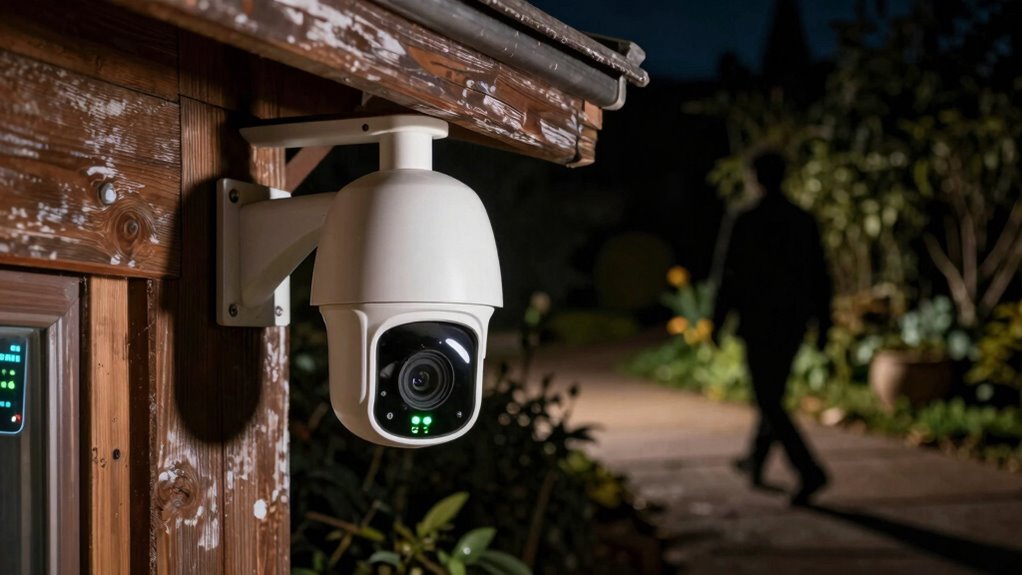
Testing and fine-tuning your camera’s night motion detection settings is essential to guarantee reliable alerts and minimize false alarms. Start by adjusting camera placement to ensure it’s aimed at high-traffic areas without obstructions. Consider the lighting conditions; make certain there’s enough ambient light for the camera to detect motion accurately without overexposure. Properly recognizing early warning signs can help prevent missed detections during critical moments.
Fine-tune your camera’s night motion detection to ensure reliable alerts and reduce false alarms.
To optimize performance, focus on:
- Adjusting detection sensitivity to match your environment and reduce false triggers
- Testing different angles and distances to find the best camera placement
- Monitoring results during various lighting conditions to refine settings
Common Mistakes to Avoid When Setting Up Night Motion Detection
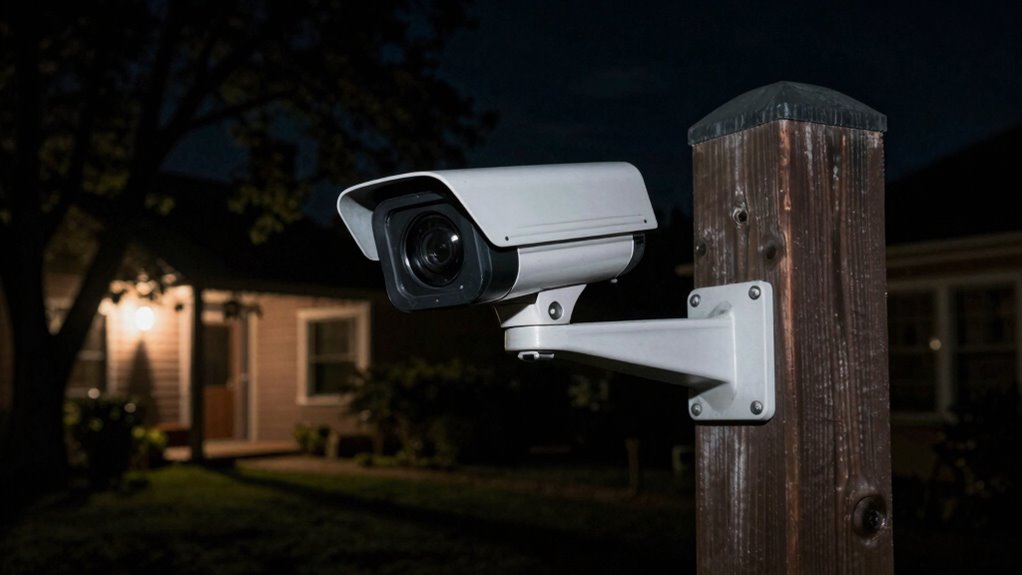
One common mistake people make when setting up night motion detection is neglecting to properly position the camera. Poor camera placement can cause blind spots or false alerts due to uneven lighting conditions. You should avoid mounting the camera where lighting fluctuates or where shadows can trigger motion detection unnecessarily. Make sure to position it at an angle that maximizes visibility of key areas without obstructions. Additionally, consider how lighting conditions change at night—ensure the camera’s field of view isn’t affected by streetlights or passing headlights, which can cause false alarms. Proper camera placement guarantees maximum performance, reduces false triggers, and captures clear motion detection footage during the night. Don’t overlook the importance of strategic positioning for reliable night security.
Frequently Asked Questions
Can Outdoor Cameras Differentiate Between Humans and Animals at Night?
Yes, outdoor cameras can often differentiate between humans and animals at night. They use infrared sensitivity and thermal imaging to identify heat signatures, helping reduce false alarms from small animals. Advanced cameras analyze movement patterns and size, enabling better detection accuracy. You should select models with these features to improve night-time identification, ensuring your security system responds appropriately without unnecessary alerts.
Do Different Camera Brands Have Unique Night Motion Detection Features?
Think of camera brands as different chefs, each with their own secret ingredients. Yes, they have unique night motion detection features, often leveraging infrared technology and adjustable motion sensitivity. Some brands excel at reducing false alarms, while others offer advanced settings for better detection. When choosing a camera, compare these features to find one that best suits your needs, ensuring your outdoor security is as sharp as a hawk in the night.
How Does Weather Affect Night Motion Detection Performance?
Weather effects, like rain, snow, or fog, can impact your camera’s night motion detection by reducing visibility and causing false alerts. Extreme weather may also interfere with sensor sensitivity, making it harder for your camera to distinguish real motion from environmental noise. To improve performance, you should adjust the sensitivity settings accordingly and consider weather-resistant cameras that perform better under adverse conditions.
Are There Legal Considerations for Outdoor Night Surveillance?
You should be aware that outdoor night surveillance raises privacy concerns and may be subject to surveillance regulations. Make sure you comply with local laws, which often restrict recording in private spaces or require notifications. Respect neighbors’ privacy and avoid pointing cameras toward private areas. Staying informed about privacy laws helps you avoid legal issues, ensuring your security measures are both effective and lawful.
Can I Integrate Outdoor Cameras With Existing Security Systems?
Yes, you can integrate outdoor cameras with your existing security system. Focus on proper camera placement and guarantee your new cameras have high resolution for clear footage. By matching the camera resolution and compatibility, you create a seamless setup that enhances security. Juxtapose advanced technology with traditional systems to maximize coverage and efficiency. With the right integration, you’ll get reliable monitoring that’s easy to manage and upgrade over time.
Conclusion
Properly setting up your outdoor security camera can considerably improve night motion detection. Did you know that cameras with well-adjusted settings can reduce false alarms by up to 50%? By fine-tuning sensitivity, zones, and timing, you’ll catch genuine activity while minimizing distractions. Take the time to test and adjust your settings regularly—your peace of mind depends on it. With just a few tweaks, you’ll stay protected and ensure your camera works exactly when you need it most.
Halloween Picks
halloween
As an affiliate, we earn on qualifying purchases.