
TL;DR

Get pool and patio gear delivered free — and shop member deals
- Fast, free delivery on millions of items
- Access to Prime Big Deal Days deals on October 6–7
- Prime Video, Amazon Music and more included
Researchers at Western University have developed a foam-backed floating solar PV system with air bubblers to enhance performance in cold climates. The system shows promising energy yield and ice prevention benefits, though commercial viability remains under evaluation.
Researchers at Western University have developed and tested a foam-backed floating solar PV system incorporating air bubblers to address cold climate challenges, including ice formation. This innovation aims to improve solar efficiency and water conservation in colder regions, marking a significant step toward expanding floating solar into new environments.
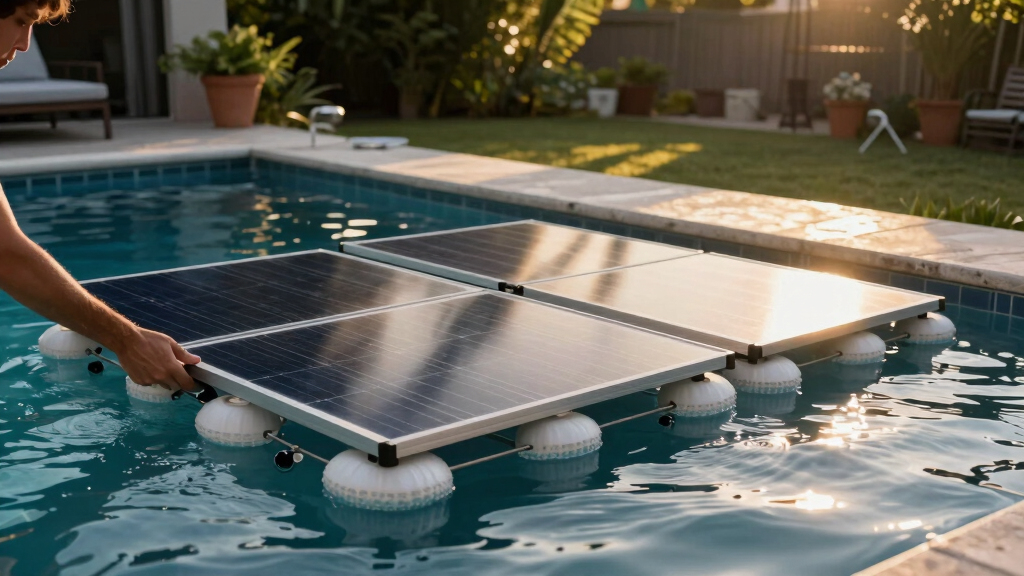
The foam-based floating PV system attaches solar modules to polyethylene foam slabs, which provide insulation and keep the panels approximately 1 centimeter above water. The inclusion of air bubblers, which use minimal energy, helps prevent ice buildup on the water surface during cold weather. Experimental setups demonstrated that this system not only reduced ice formation but also increased annual energy yield compared to traditional floating PV models.
According to an author involved in the research, Joshua M. Pearce, the foam-based design offers a cost-effective solution for cold climates and enhances water evaporation reduction, which benefits water conservation efforts. The system’s performance was validated through real-world testing in winter conditions, with images showing the system with and without bubblers under snow and ice. The findings suggest that foam-backed floating PV could be a viable option for cold regions, although further research is needed for large-scale deployment.
Potential Impact of Foam-Based Floating PV in Cold Regions
This development could significantly expand the geographic reach of floating solar PV technology, enabling deployment in colder climates where ice formation and efficiency loss have been barriers. The foam-backed system’s improved insulation and ice mitigation techniques could lead to more reliable and cost-effective solar energy generation in these regions, supporting broader renewable energy adoption and water conservation goals.
As an affiliate, we earn on qualifying purchases.
Advances in Floating Solar and Cold Climate Challenges
Floating solar PV has grown rapidly over the past decade, with global installations reaching over 10 GW by 2025. However, most systems are optimized for warm climates, with cold regions facing issues like ice buildup and reduced efficiency. Previous research has explored various methods to adapt floating PV for colder environments, but practical, economical solutions remain limited. The recent foam-backed design with air bubblers builds on this ongoing effort to overcome climate-specific challenges, with early experimental results showing promise for broader application.
“The foam-based FPV generated more energy annually compared to other PV models, emphasizing the importance of accurate temperature modeling for cold-climate systems.”
— an anonymous researcher
Uncertainties About Large-Scale Implementation
While experimental results are promising, it remains unclear how well the foam-based floating PV with air bubblers will perform at commercial scales. Questions about long-term durability, cost competitiveness, and integration into existing energy infrastructure are still open. Further large-scale testing and economic analysis are needed to determine viability beyond laboratory conditions.
Next Steps for Research and Deployment
Researchers plan to conduct larger pilot projects to evaluate the system’s performance over extended periods and across diverse cold water bodies. They also aim to optimize the design for cost and ease of installation, with the goal of assessing commercial feasibility. Regulatory and market considerations will also influence potential adoption in cold climate regions.
Key Questions
How does the foam backing improve floating solar performance in cold climates?
The foam provides insulation, reducing heat loss and helping maintain optimal panel temperatures, while also keeping the panels slightly above water to prevent ice contact and buildup.
What role do air bubblers play in this floating solar system?
The air bubblers generate small bubbles that disrupt ice formation on the water surface, helping to keep the panels clear and operational during winter conditions.
Is this foam-based floating PV system cost-effective compared to traditional systems?
Preliminary studies suggest it is economically viable in cold climates, but comprehensive cost analysis at larger scales is still underway.
Could this technology be used in warm climates as well?
While designed primarily for cold environments, the foam-backed system could also offer benefits in warm climates by providing insulation and reducing water evaporation, but further research is needed.
When might this technology be available for commercial deployment?
Large-scale testing and economic assessments are ongoing; commercial deployment could be several years away depending on research outcomes and market readiness.
Source: CleanTechnica
Fall Picks
fall essentials
As an affiliate, we earn on qualifying purchases.