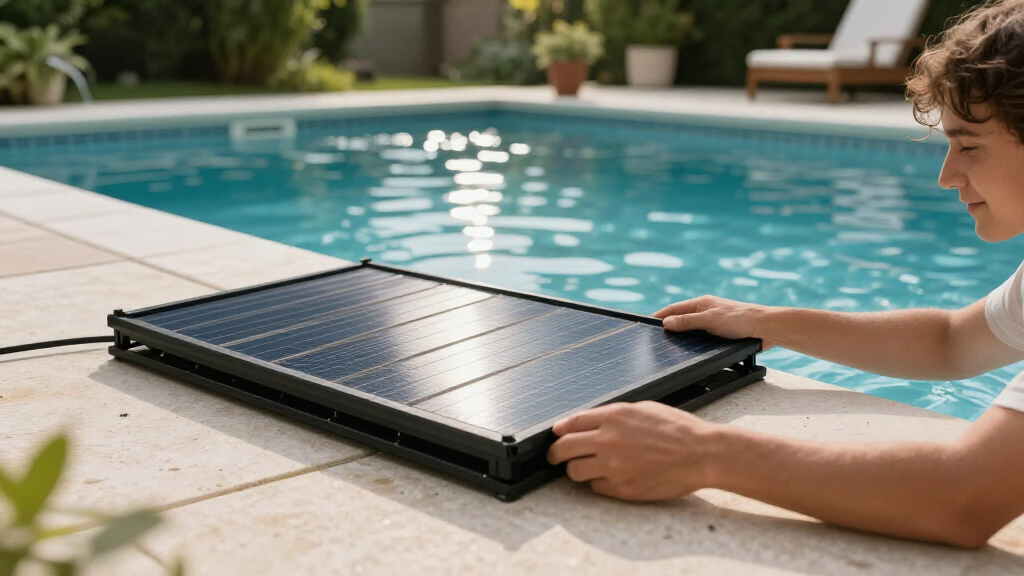

Solar pool heaters split into two camps: full panel systems that tie into your pump and filter, and simple solar mats that sit in the sun and warm water passively. The Industrial Grade Solar Pool Heater DIY Kit (4×10.5 ft, 168 sq ft) earns my best overall pick for its high-wind strapless mounting and freeze resistance — features most competitors leave out entirely. For value, the Doheny’s 2.5′ x 20′ Collector Kit covers serious square footage at a beginner-friendly price, while the Universal 4′ x 12′ replacement panels suit owners upgrading or expanding an existing system. The main tradeoffs you’ll face are collector area versus roof/rack space, header size (1.5″ vs 2″ I.D.) versus pump power, and upfront cost versus a 15–20 year lifespan. Keep reading for the full breakdown.

Get pool and patio gear delivered free — and shop member deals
- Fast, free delivery on millions of items
- Access to Prime Big Deal Days deals on October 6–7
- Prime Video, Amazon Music and more included
Complete the kit


Key Takeaways
- Collector area is the single biggest performance factor: the Industrial Grade kit’s 168 sq ft outpaces the Intex mats by roughly 20x, which shows up directly in degrees gained per day.
- The Intex mats are the only options here that don’t require plumbing into your pump and filter loop, making them the sole true plug-and-play choice — but only for small above-ground pools.
- Header size quietly determines compatibility: 1.5″ I.D. headers match most standard above-ground pumps, while the 2″ I.D. Universal panel needs higher-flow systems to avoid restricting circulation.
- Freeze and wind resistance separated the premium kits from commodity panels — most budget panels crack after a hard winter if not drained properly, while the Industrial Grade kit is built for it.
- Replacement panels (the 4′ x 12′ and 4′ x 8′ Universal options) only make sense if you already have mounting hardware and plumbing; buying them as a first system costs more than a complete kit.
| Intex 47 Inch x 47 Inch Solar Pool Heater Mat (2 Pack) |  | Best Value for Small Above Ground Pools | Dimensions (each mat): 47.25 x 47.25 inches | Quantity: 2 mats per pack | Pool Capacity Compatibility: Up to 8,000 gallons | VIEW LATEST PRICE | See Our Full Breakdown |
| Industrial Grade Solar Pool Heater DIY Kit – High-Wind Strapless Mounting & Freeze Resistance (4×10.5 ft, 168 sq ft) |  | Best Premium System | Panel Size: 4 ft x 10.5 ft | Total Collector Area: 168 square feet | Mounting System: High-wind strapless | VIEW LATEST PRICE | See Our Full Breakdown |
| Universal Solar Pool Heater Panel Replacement – 4′ x 12′ / 2″ I.D. Header, 15-20 Year Life |  | Best Long-Term Durability | Panel Size: 4 ft x 12 ft | Header Diameter: 2 inches I.D. | Life Expectancy: 15-20 years | VIEW LATEST PRICE | See Our Full Breakdown |
| Doheny’s Solar Heating Systems for Above Ground Swimming Pools (2.5′ x 20′ Collector Kit) |  | Best Complete Starter Kit | Collector Size: 2.5 ft x 20 ft | Heat Output: 40,000 BTU | Included Components: Panels, mounting hardware, diverter valve | VIEW LATEST PRICE | See Our Full Breakdown |
| Intex Solar Pool Water Heater Mat for Above Ground Pools |  | Best Budget Pick for Beginners | Dimensions: 47.25 x 47.25 inches | Surface Area: 11 square feet | Temperature Gain: Approximately 5-9°F | VIEW LATEST PRICE | See Our Full Breakdown |
| Universal Solar Pool Heater Panel Replacement – 4′ x 12′ / 1.5″ I.D. Header | | Best Replacement Panel for Full-Size Systems | Size: 4′ x 12′ | Collector Area: 48 sq ft | Header Diameter: 1.5 inches I.D. | VIEW LATEST PRICE | See Our Full Breakdown |
| DIY Solar Pool Heater Kit – 15-20 Year Life Expectancy (4-4×10 / 1.5″ I.D. Header) | 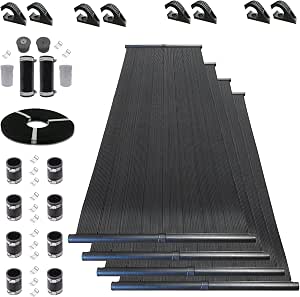 | Best Complete DIY System | Type: Solar Pool Heater Kit | Number of Panels: 4 panels (4′ x 10′ each) | Total Collector Area: 160 sq ft | VIEW LATEST PRICE | See Our Full Breakdown |
| Universal Solar Pool Heater Panel Replacement – 4′ x 8′ / 1.5″ I.D. Header |  | Best for Tight Roofs and Small Arrays | Size: 4′ x 8′ | Collector Area: 32 sq ft | Header Diameter: 1.5 inches I.D. | VIEW LATEST PRICE | See Our Full Breakdown |
| solar pool heater | Material | Life Expectancy |
|---|---|---|
| Intex 47 Inch x 47 Inch Solar | Durable vinyl | — |
| Industrial Grade Solar Pool He | — | — |
| Universal Solar Pool Heater Pa | High-grade materials with UV stabilizers | 15-20 years |
| Doheny’s Solar Heating Systems | — | — |
| Intex Solar Pool Water Heater | UV stabilized PVC | — |
| Universal Solar Pool Heater Pa | High-grade materials with UV stabilizers | 15-20 years |
| DIY Solar Pool Heater Kit | High-grade materials with UV stabilizers | 15-20 years |
| Universal Solar Pool Heater Pa | High-grade UV-stabilized materials | 15-20 years |
More Details on Our Top Picks
Intex 47 Inch x 47 Inch Solar Pool Heater Mat (2 Pack)
For the price of a single rigid panel, this two-mat bundle doubles your collector surface and covers pools up to 8,000 gallons. Compared with Doheny’s 2.5′ x 20′ collector kit, the upfront cost is dramatically lower, and setup is as simple as laying the mats in the sun and hooking them into your existing filter line. Realistic expectations matter here: a 5 to 9°F gain is meaningful for a small pool but modest against what larger flat-plate systems deliver. The vinyl build holds up to a season or two of UV exposure, but it will not approach the 15-20 year lifespan of the Universal replacement panels. Pairing both mats in series is the smart play — a single mat on a full-size pool barely moves the needle.
Pros:- Two mats included for roughly the price of one competitor panel
- Raises water temperature a real 5-9°F on suitably sized pools
- Connects to existing Intex-style filter systems with no tools
- Vinyl construction handles daily sun better than budget mats
Cons:- Requires a filter pump of at least 1/2 HP, which excludes many entry-level Intex pumps
- Output collapses on cloudy days and in shoulder seasons
- Mats are portable but vulnerable to punctures compared with rigid panels
Best for: Owners of above ground pools under 8,000 gallons who want a low-cost, plug-in heating boost without any mounting or plumbing project
Not ideal for: In-ground pool owners or anyone expecting gas-heater performance — these mats lack the surface area and durability for permanent installations
- Dimensions (each mat):47.25 x 47.25 inches
- Quantity:2 mats per pack
- Pool Capacity Compatibility:Up to 8,000 gallons
- Temperature Gain:Approximately 5-9°F
- Material:Durable vinyl
- Required Pump:Compatible filter pump up to 1/2 HP
- Pool Type:Above ground only
Our verdict“The cheapest credible way to take the chill off a small above ground pool, provided your pump can push water through both mats.”
Industrial Grade Solar Pool Heater DIY Kit – High-Wind Strapless Mounting & Freeze Resistance (4×10.5 ft, 168 sq ft)
This is the heavyweight of the lineup: 168 square feet of collector area, a patented strapless high-wind mounting system, and construction rated to survive freezes that crack cheaper panels. Compared with the Universal 4′ x 12′ replacement panel, you give up a little collector width but gain a complete kit engineered for roof mounting in storm-prone regions — no straps to chafe, fewer penetrations in your roof. The tradeoff is real: this is a serious DIY project involving plumbing runs, valves, and roof work. Someone comfortable with the Intex mats or Doheny’s ground-rack kit will find this over their head, and hiring an installer eats into the value proposition. For permanent, whole-season heating of a large pool, though, nothing else in this batch competes on durability.
Pros:- Largest collector area in this batch at 168 square feet
- Strapless mounting survives storm winds that tear strap-mounted panels loose
- Freeze-resistant construction extends year-round durability
- High-flow design maintains strong circulation without overworking the pump
Cons:- Installation demands plumbing and roofing skills most homeowners don’t have
- Total cost runs well beyond plug-in mats once mounting and piping are factored in
- Overkill for pools under roughly 15,000 gallons
Best for: Experienced DIYers in windy or freeze-prone climates who want a permanent, roof-mounted system for a large pool
Not ideal for: Renters and casual pool owners — the installation complexity and permanent mounting make no sense for a pool you may not keep for a decade
- Panel Size:4 ft x 10.5 ft
- Total Collector Area:168 square feet
- Mounting System:High-wind strapless
- Freeze Resistance:Rated for maximum freeze resistance
- Construction:Durable, patented crack-resistant design
- Installation:Roof or rack mount, DIY kit
- Maintenance:Low
Our verdict“A buy-once, heat-for-decades system for hands-on owners in harsh climates — everyone else should start smaller and cheaper.”
Universal Solar Pool Heater Panel Replacement – 4′ x 12′ / 2″ I.D. Header, 15-20 Year Life
Where the Intex mats are a seasonal consumable, this 4′ x 12′ panel is infrastructure: a 15-20 year life expectancy, UV-stabilized materials, and a hybrid loose-tube/flat-plate absorber that pushes heat transfer closer to what premium systems achieve. The 2-inch I.D. header is the key spec — it suits high-flow setups and larger plumbing, which is exactly why this panel belongs in bigger installations than the 1.5″ versions elsewhere in this roundup. The tradeoff is that it ships as a replacement panel, not a turnkey kit: no valves, no mounting hardware, no hoses. You are buying the collector alone and building the system around it. Installation mistakes directly cost you efficiency, and non-standard pool plumbing may need adapters or professional help to mate with the rubber hose connections.
Pros:- 15-20 year rated lifespan far exceeds vinyl mat alternatives
- 2-inch header supports high flow rates for large pools
- Hybrid absorber design improves heat capture over basic flat panels
- Flexible joints absorb thermal expansion, reducing crack failures
Cons:- Panel only — valves, mounting hardware, and piping sold separately
- Performance depends heavily on correct installation and orientation
- Universal fit still may not mate with non-standard pool setups
Best for: Owners of existing solar heating systems replacing worn panels, or builders speccing a large custom array with 2-inch plumbing
Not ideal for: First-time solar buyers — with no included hardware or instructions for a complete system, this panel assumes you already know what you’re doing
- Panel Size:4 ft x 12 ft
- Header Diameter:2 inches I.D.
- Life Expectancy:15-20 years
- Absorber Design:Hybrid loose-tube and flat plate
- Material:High-grade materials with UV stabilizers
- Connections:Universal rubber hose compatibility
- Included Hardware:Panel only
Our verdict“The right panel if you’re committed to solar for the long haul and already have (or can build) the supporting system around it.”
Doheny’s Solar Heating Systems for Above Ground Swimming Pools (2.5′ x 20′ Collector Kit)
This kit earns its spot by being genuinely complete: panels, mounting hardware, and a diverter valve in one box, rated at 40,000 BTU. That diverter valve is the detail that separates it from the Intex mats — it lets you bypass the collector at night or on cloudy days so you’re not actively cooling your pool, something budget mats can’t do. It sits neatly between the Intex mats and the industrial-grade DIY kit: more heating power and system logic than the mats, far less complexity than the 168 sq ft premium build. The catch is that PVC and flex piping are not included, and ground-rack buyers will need a separate roof/rack mounting kit. Read the box carefully before install day, or you’ll be making a hardware store run mid-project. As with all solar collectors, output tracks the sun — this is a season-extender, not an all-weather heater.
Pros:- Diverter valve allows bypassing the collector to prevent nighttime heat loss
- Includes mounting hardware, unlike bare replacement panels
- 40,000 BTU output comfortably beats two Intex mats
- Sizing options accommodate a range of above ground pool volumes
Cons:- PVC or flex pipes not included — budget extra for plumbing supplies
- Roof or rack mounting requires a separately purchased kit
- Heating output drops sharply during cloudy or cool weather
Best for: Above ground pool owners upgrading from mats who want a real plumbed system with flow control at a mid-range price
Not ideal for: Anyone expecting an open-and-install experience — the missing piping and optional mounting kit mean extra purchases and planning
- Collector Size:2.5 ft x 20 ft
- Heat Output:40,000 BTU
- Included Components:Panels, mounting hardware, diverter valve
- Not Included:PVC/flex pipes; roof or rack mounting kit
- Pool Type:Above ground
- Installation:Ground, roof, or rack mount
- Power Source:Solar
Our verdict“The most sensible first step into plumbed solar heating, as long as you budget for the piping the box leaves out.”
Intex Solar Pool Water Heater Mat for Above Ground Pools
This single Intex mat is the lowest-commitment entry point into solar pool heating. Unlike its two-pack sibling, it works with filter pumps as small as 1/3 HP or 2,000 GPH, which means owners of basic Intex or Coleman cartridge pump setups can use it without upgrading equipment. The tradeoff for that accessibility is surface area: 11 square feet will nudge a small pool up 5-9°F in good sun but can’t match the 40,000 BTU output of Doheny’s collector kit or the scale of the industrial-grade system. Its strongest practical feature is portability — it folds flat for winter storage, something no rigid panel can do. Buy this to test whether solar heating fits your routine and climate before committing hundreds more to a permanent array.
Pros:- Works with common 1/3 HP / 2,000 GPH filter pumps — no pump upgrade needed
- Folds flat for off-season storage
- Lowest-cost way to experiment with solar heating
- UV-stabilized PVC survives a full season of daily sun
Cons:- Single 11 sq ft mat is underpowered for pools near its 8,000-gallon rating
- Heating results vary heavily with weather and sun angle
- Above ground pools only — no path to in-ground use
Best for: Owners of small above ground pools with entry-level 1/3 HP pumps who want to try solar heating for minimal money
Not ideal for: Pools near the 8,000-gallon ceiling or larger — one mat’s output is too modest to make a noticeable difference on big volumes
- Dimensions:47.25 x 47.25 inches
- Surface Area:11 square feet
- Temperature Gain:Approximately 5-9°F
- Hose Attachment:1.25-inch
- Pump Compatibility:Filter pumps up to 1/3 HP or 2,000 GPH
- Suitable Pool Size:Up to 8,000 gallons
- Material:UV stabilized PVC
- Weight:6.41 pounds
Our verdict“A cheap, low-risk trial run at solar heating for small pools — just don’t expect it to carry a full-size swim season.”
Universal Solar Pool Heater Panel Replacement – 4′ x 12′ / 1.5″ I.D. Header
At 48 square feet of collector area, this 4′ x 12′ panel is the workhorse of the replacement category, and it’s built for homeowners repairing an existing rubber-hose solar array rather than starting from scratch. The 1.5″ header matches the most common residential plumbing size, so it drops into arrays from major brands without adapters. Compared with the 4′ x 8′ version from the same line, you get 50% more collector area per panel, which means fewer roof penetrations and connections to maintain for the same total output. The flexible tube joints are the quiet differentiator here — they absorb thermal expansion instead of cracking at the seams, which is usually what kills cheaper flat-plate panels. The tradeoff: this is a panel only, not a kit, so it assumes your mounting, hoses, and plumbing already exist.
Pros:- Large 48 sq ft collector area maximizes heat gain per panel
- Flexible joints absorb thermal expansion, extending panel life
- UV-stabilized materials rated for 15-20 years of sun exposure
- Universal 1.5″ header fits most standard hose-and-clamp systems
Cons:- Panel only — hoses, clamps, and mounting hardware sold separately
- Heating output depends heavily on existing system flow rate and placement
Best for: Owners of an aging rubber-hose solar array who need to swap failed panels without replacing the whole system
Not ideal for: Anyone starting from zero — with no hardware, couplings, or mounting included, a first-time buyer should look at the DIY Solar Pool Heater Kit instead
- Size:4′ x 12′
- Collector Area:48 sq ft
- Header Diameter:1.5 inches I.D.
- Life Expectancy:15-20 years
- Material:High-grade materials with UV stabilizers
- Connection Type:Rubber hoses and hose clamps
- Origin:Made in the U.S.
Our verdict“If one or two panels in your existing array have failed, this is the most sensible way to restore full heating capacity without a full teardown.”
DIY Solar Pool Heater Kit – 15-20 Year Life Expectancy (4-4×10 / 1.5″ I.D. Header)
Unlike every replacement panel in this roundup, this option ships as a complete four-panel kit with the hardware and installation guidance included — that’s 160 square feet of collector, enough to meaningfully warm a typical in-ground pool. Compared with the Industrial Grade DIY Kit with strapless high-wind mounting, this kit trades that premium mounting system for a lower overall cost, which makes it the smarter pick for sheltered roofs but a weaker choice on exposed coastal sites. The 15-20 year life expectancy puts it well ahead of softgoods like the Intex Solar Heater Mat, which is a seasonal product at best. The honest tradeoff: this is still a real plumbing project. You need an existing pump and filtration system, and first-timers should expect a full weekend of roof work and leak-checking before it’s running.
Pros:- Complete kit includes all hardware and installation support, not just panels
- 160 sq ft of total collector area handles substantial heating loads
- 15-20 year rated lifespan far outlasts mat-style solar heaters
- High-efficiency absorber design improves heat transfer per square foot
Cons:- Requires a working pump and filtration system — not standalone
- Installation is genuinely involved and may need a second person or a pro
- Sizing is fixed; smaller or unusually shaped pools may not match the kit layout
Best for: Handy homeowners building their first full solar heating system on a moderate-sized pool with an existing pump
Not ideal for: Renters or above-ground pool owners with small setups — the four-panel footprint is overkill and assumes permanent roof or rack mounting
- Type:Solar Pool Heater Kit
- Number of Panels:4 panels (4′ x 10′ each)
- Total Collector Area:160 sq ft
- Header Size:1.5 inches I.D.
- Life Expectancy:15-20 years
- Material:High-grade materials with UV stabilizers
- Includes:All necessary hardware and installation support
- Requirement:Existing pump and filtration system
Our verdict“This is the pick when you want to go solar end-to-end in one purchase and you’re willing to put in the installation labor yourself.”
Universal Solar Pool Heater Panel Replacement – 4′ x 8′ / 1.5″ I.D. Header
The 4′ x 8′ footprint is the most space-flexible panel in this lineup — it fits roof sections, pergolas, and rack positions where a 4′ x 12′ panel simply won’t go, making it the go-to for irregular rooflines or adding capacity in small increments. Its hybrid loose-tube and flat-plate absorber design is a step up in wind and freeze tolerance compared with purely flat construction, since individual tubes can flex independently. Compared with the larger 4′ x 12′ replacement panel, you trade collector area per connection for layout freedom — more panels means more hose joints to install and eventually maintain, so the math only works if space constraints are real. Like its bigger sibling, it’s a replacement component, not a kit, so budget for hoses, clamps, and mounting if you don’t already have them.
Pros:- Compact 4′ x 8′ footprint fits tight or irregular mounting spaces
- Hybrid loose-tube/flat-plate absorber handles wind and temperature swings better
- Universal rubber-hose compatibility matches standard 1.5″ systems
- Same 15-20 year UV-stabilized lifespan as the larger panels
Cons:- Smaller collector area means you need more panels and connections for equal output
- No hardware included — hoses, clamps, and mounting bought separately
- Installation requires moderate plumbing skill
Best for: Pool owners with limited or awkwardly shaped roof space who need to squeeze solar heating into tight spots
Not ideal for: Owners with ample south-facing roof space — the 4′ x 12′ panel delivers more heat per connection and less long-term maintenance
- Size:4′ x 8′
- Collector Area:32 sq ft
- Header Diameter:1.5 inches I.D.
- Life Expectancy:15-20 years
- Material:High-grade UV-stabilized materials
- Absorber Design:Hybrid loose-tube and flat plate
- Connection Type:Rubber hoses and hose clamps
Our verdict“Choose this panel when roof geometry, not budget, is the limiting factor in your solar heating setup.”
How We Picked
I evaluated each heater against four buyer-facing criteria: heating output relative to pool size, installation complexity, durability against freeze, wind, and UV exposure, and total cost of ownership including plumbing extras. Heating output came down to collector area and flow design — a panel that doubles your surface coverage does more for your water temperature than any marketing claim. Installation complexity mattered because the difference between a strap-mount panel and a hose-mat system is the difference between a weekend plumbing project and a five-minute setup.
The ranking logic follows a simple principle: systems that deliver more usable heat per dollar, with fewer failure points, rank higher. The Industrial Grade DIY kit leads because it solves the two problems that kill most solar panels — wind uplift and freeze cracking. Doheny’s ranks as best value because it balances coverage and price for typical above-ground pools. The Universal replacement panels rank by fit-for-purpose rather than absolute performance, since they serve expanders and repairers, not first-time buyers. The Intex mats rank lowest for heating power but win outright for beginners with small pools.
| solar pool heater | Material |
|---|---|
| Intex 47 Inch x 47 Inch Solar | Durable vinyl |
| Industrial Grade Solar Pool He | — |
| Universal Solar Pool Heater Pa | High-grade materials with UV stabilizers |
| Doheny’s Solar Heating Systems | — |
| Intex Solar Pool Water Heater | UV stabilized PVC |
| Universal Solar Pool Heater Pa | High-grade materials with UV stabilizers |
| DIY Solar Pool Heater Kit | High-grade materials with UV stabilizers |
| Universal Solar Pool Heater Pa | High-grade UV-stabilized materials |
Factors to Consider When Choosing Solar Pool Heaters
Before you commit to a specific heater, it helps to understand how solar pool heating actually works and where buyers most often go wrong. These are the factors that matter more than brand names or price tags.
Match Collector Area to Pool Size
The most common mistake in this category is undersizing the collector area. Industry guidance suggests your total panel coverage should be 50–100% of your pool’s surface area, depending on your climate and how warm you want the water. A single 4′ x 8′ panel might add a few degrees to a 12-foot round pool, but it will barely register on a 24-footer. Buyers often see a low price on a small panel kit, buy it, and conclude solar heating “doesn’t work” — when the real issue was coverage. Larger systems like a 168 sq ft array cost more upfront but are the only realistic path to a genuinely swimmable extension of your season. When comparing prices, always calculate the cost per square foot of collector, not the sticker price alone.
Check Header Size and Pump Compatibility
Solar panels connect through headers — the pipes that feed water across the collector — and their internal diameter (1.5″ vs 2″ I.D.) must match your plumbing and pump capacity. A 2″ header moves more water with less resistance, which suits in-ground pools with stronger pumps. Forcing a 2″ header onto a small above-ground pump with adapters typically produces weak flow and poor heat transfer. Conversely, a 1.5″ header on a high-flow system can become a bottleneck that makes your pump work harder than it should. Before buying anything, check your pump’s flow rating and your existing hose diameter. This is the detail most product listings bury, and it’s the number one cause of returns in this category.
Mounting and Wind Exposure
Panels live outdoors on roofs, racks, or the ground, and wind uplift is the leading cause of solar panel failure. Conventional strap-mounted panels can flap, flex, and eventually crack at the seams in gusty conditions — especially on rooftops where airflow is strongest. Some premium kits now use strapless mounting systems that clamp the panel rigidly along its full length, which dramatically reduces flex-related fatigue. If you’re mounting on the ground, wind matters less but shading from fences and landscaping matters more. Think honestly about where the panels will actually live. A cheaper panel mounted in a sheltered, full-sun spot will outperform a premium panel half-shaded by afternoon tree cover.
Freeze Resistance and Winterization
Water left inside a collector over winter will freeze, expand, and split the panel’s internal channels — a failure that’s invisible until spring, when the panel leaks instead of heating. Most standard panels must be drained and drained thoroughly every fall, and even careful owners lose panels to a trapped pocket of water. Freeze-tolerant designs use more elastic materials and drain-friendly channel geometry, which is a genuine upgrade if you live anywhere with hard freezes and don’t want to babysit your heater every October. In mild climates, this feature matters less and standard panels are a reasonable savings. Match this decision to your actual winter, not the worst-case scenario a sales page describes.
Kit Versus Replacement Panel
Some products in this category are complete kits with mounting hardware and plumbing, while others are bare replacement panels meant to slot into an existing array. This distinction is easy to miss in listings and expensive to get wrong. If you’re starting from zero, a bare panel means separately sourcing straps, clamps, hoses, valves, and a bypass kit — often adding 30–50% to the real cost. If you already have a system with a cracked or aged panel, buying a full kit wastes money on hardware you don’t need. Replacement panels also let you expand incrementally, adding a 4′ x 8′ panel each season as budget allows. Know which type of buyer you are before comparing prices at all.
Realistic Temperature Expectations
Solar pool heaters are temperature boosters, not hot tub heaters. A properly sized system typically raises water temperature 10–15°F above an unheated pool in good conditions, and output swings with cloud cover, sun angle, and air temperature. Any product implying more than that is stretching the truth. Timing also matters: run your pump during peak sun hours (roughly 10 a.m. to 4 p.m.), because water circulating through panels at night loses heat rather than gaining it. A solar cover used alongside your panels multiplies results dramatically by stopping overnight heat loss — the single cheapest upgrade most buyers skip. Set expectations around weeks of extra swimming season, not year-round swimming.
Frequently Asked Questions
How many solar panels do I need for my pool size?
A useful starting rule is collector area equal to 50–100% of your pool’s surface area. A 15-foot round pool (about 175 sq ft of surface) needs roughly 90–175 sq ft of panel coverage depending on your climate; a 24-footer (about 450 sq ft) needs substantially more than any single kit in this roundup provides. Southern, sunny climates can aim toward the low end, while northern or windy sites should push toward the high end. This is why expandable systems matter: starting with a 40 sq ft kit on a large pool will produce disappointing results no matter how good the panel is. Calculate your pool’s surface area first, then compare each kit’s total collector coverage against that target.
Do solar pool heater mats actually work, or should I buy panels?
Mats like the Intex models do warm water, but only for small above-ground pools in the 10–15 foot range, and only modestly — expect a few degrees on sunny days rather than the 10°F+ that properly sized panels deliver. Their appeal is total simplicity: no plumbing, no pump modification, no mounting hardware, and a price under fifty dollars. Panels require real installation effort and a stronger pump, but they scale to any pool size and integrate with your existing circulation. The honest answer is that mats are a low-risk experiment for small pools, while panels are an investment for people who swim regularly. If your pool holds more than roughly 5,000 gallons, a mat is more novelty than heater.
Can I mix 1.5″ and 2″ I.D. header panels in one system?
You can with reducer fittings, but it’s usually a mistake. Mixing header sizes creates flow imbalance, where water preferentially travels the path of least resistance and some panels barely circulate. That means uneven heating and panels that collect heat without transferring it. If your pump pushes 1.5″ plumbing, stick with 1.5″ headers across the whole array; the 2″ Universal panel makes sense only when your entire system is built around 2″ lines. The exception is a sequential (series) plumbing layout, where mixed sizes cause fewer problems than a parallel layout. Most homeowners will get better results matching sizes throughout and keeping the layout parallel for even flow.
Do I need a bypass valve with my solar heater?
Yes, in almost every panel-based system. A bypass valve lets water skip the solar panels when you don’t want heating — at night, on cool cloudy days, or when the pool has reached your target temperature. Without one, your pump forces water through the collector constantly, and on a chilly evening that actively chills your pool. A basic three-port valve kit costs far less than the heat you’d otherwise lose. Many budget kits omit this part to hit a price point, so factor it into your true cost comparison. If a kit includes a bypass or diverter valve, that’s a genuine value add, not a bonus accessory.
How long do solar pool heaters last, and what fails first?
Quality polypropylene panels are rated for 15–20 years, but that lifespan assumes proper mounting, winterization, and sun exposure. The failures that end panel life early are almost always the same three: wind-induced flex cracking at the seams, freeze damage from trapped water, and UV degradation of cheap plastic formulations. Mounting quality matters as much as panel quality — a rigidly clamped budget panel often outlasts a loosely strapped premium one. Watch for small weeps at the header connections as an early warning sign, since those stress points go first. Spending more on freeze-tolerant, rigidly mounted construction pays for itself if it avoids even one premature replacement.
Conclusion
The right pick depends entirely on your pool and your patience for installation. For best overall, the Industrial Grade Solar Pool Heater DIY Kit stands out with 168 sq ft of coverage, strapless wind-resistant mounting, and freeze tolerance — the features that determine whether a system survives a decade or a single season. For best value, Doheny’s 2.5′ x 20′ Collector Kit delivers large-system heating at a price that suits most above-ground pool owners.
For beginners and small above-ground pools, the Intex solar mats (the 2-pack 47″ version for slightly more coverage) require no plumbing knowledge whatsoever — just accept their limited heating power honestly. For best premium/expandable setup, the Universal 4′ x 12′ replacement panels with 2″ headers suit owners with strong pumps building a serious long-term array, while the 4′ x 8′ and 1.5″ I.D. Universal panels and the DIY 1.5″ kit fit existing systems and standard-pump owners repairing or expanding. Match the header size to your pump, the collector area to your pool, and the durability features to your climate — get those three right and any of these heaters will earn its place on your roof.
Fall Picks
fall essentials
As an affiliate, we earn on qualifying purchases.