To quickly assess your pool, stay organized and follow the instructions carefully. Focus on key parameters like pH, chlorine, alkalinity, and stabilizer, and compare the results to their ideal ranges. Handle chemicals safely and make small, measured adjustments if needed. Keep a calm attitude to avoid overreacting, and use a systematic approach to guarantee safe and accurate decisions. Keep going—more tips will help you maintain a healthy, inviting pool with confidence.
Key Takeaways
- Organize testing supplies beforehand for quick, efficient testing.
- Focus on key parameters and their ideal ranges rather than reacting to minor fluctuations.
- Take a deep breath and review results calmly before making adjustments.
- Make small, measured chemical adjustments to avoid overcorrection.
- Maintain a systematic approach to testing and balancing water chemistry.

When you’re checking your pool’s water quality, it’s easy to feel overwhelmed by the numbers and worry about overreacting. The key is to stay calm and focus on quickly evaluating the results without jumping to conclusions. To do that, you need a system for reading your pool test results efficiently. First, keep your testing kit organized and ready to use. This saves time and helps you avoid confusion when you’re in a hurry. As you perform the test, follow the instructions carefully, guaranteeing you get accurate readings. Once you have the results, don’t panic if they seem off at first glance. Instead, look at the specific parameters, such as pH, chlorine levels, alkalinity, and stabilizer. Understanding the importance of chemical balance helps you interpret these numbers correctly. For example, if your pH is too high or low, it can affect the effectiveness of your sanitizer and cause skin or eye irritation. Chlorine levels that are too low won’t disinfect your pool properly, while levels that are too high can cause harshness and damage equipment. By knowing what’s ideal, you can determine whether the numbers are within safe ranges or if you need to make adjustments. Remember, safety precautions are essential. Always handle chemicals with care, wear gloves, and avoid inhaling fumes. After testing, wash your hands thoroughly and store chemicals safely away from children and pets. Regular testing and understanding water chemistry are crucial for maintaining a healthy pool. When you review your results, keep a mental checklist of what needs attention. If numbers are slightly off, you might only need a small dose of chemicals to correct the imbalance. If they’re way outside safe ranges, take immediate action, but still do so calmly. Overreacting can lead to unnecessary chemical additions, which might cause more harm than good. Instead, focus on pool testing accuracy and making measured adjustments. Properly interpreting test results is vital for avoiding overcorrection and maintaining optimal water conditions. This approach prevents overcorrection and keeps your pool water safe and balanced. Remember, pool safety and proper chemical handling are vital for a safe swimming environment. In short, the fastest way to read a pool test without overreacting involves staying organized, understanding the significance of each measurement, following safety precautions, and making measured adjustments. By keeping a clear head and trusting your knowledge, you’ll maintain a healthy, inviting pool with minimal stress. Remember, regular testing and a calm attitude are your best tools for keeping your pool water safe, clean, and enjoyable all season long.

Poolmaster 22260 5-Way Swimming Pool or Spa Water Chemistry Test Kit with Case, Essential Collection
- Water Chemistry Testing: Tests Chlorine, Bromine, pH, Acid Demand, Alkalinity
- Clear-View Test Block: Includes round test block with color chips
- Solution Set: Contains 1oz solutions of #1-#3, 0.5oz of #4-#5
As an affiliate, we earn on qualifying purchases.
As an affiliate, we earn on qualifying purchases.
Frequently Asked Questions
How Often Should I Test My Pool Water?
You should test your pool water at least twice a week to stay on top of pool maintenance and make certain proper chemical balancing. Regular testing helps you catch imbalances early, preventing issues like algae growth or cloudy water. If your pool gets heavy use or after a storm, test more frequently. Keeping a consistent schedule ensures your water stays crystal clear and safe for swimming, minimizing overreactions to minor changes.
What Do I Do if the Test Results Are Inconsistent?
Imagine your test kit as a compass—if readings are inconsistent, it’s like the compass needle wobbles. To fix this, guarantee proper test calibration and check reagent stability; expired or improperly stored reagents can skew results. Recalibrate your test kit and replace any unstable reagents. Doing so restores accuracy, guiding you to maintain safe water levels without unnecessary worry. Regular calibration keeps your pool’s health on course.
Can Temperature Affect Pool Test Readings?
Yes, temperature can affect pool test readings because it impacts chemical stability and can lead to inaccurate results. When testing, make sure your test kit is properly temperature calibrated, ideally at room temperature, to maintain accuracy. Extreme temperatures can cause chemicals to react differently, skewing your readings. Always check the test instructions for temperature guidelines, and avoid testing in very hot or cold conditions for reliable results.
Are Digital Test Kits More Accurate Than Strips?
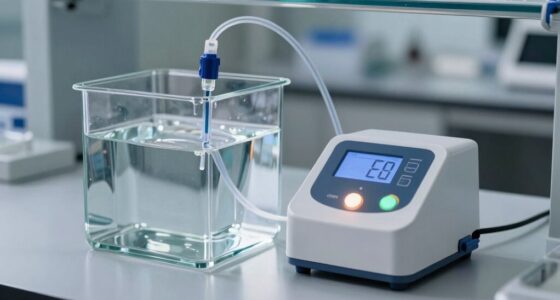
Digital test kits are generally more accurate than strips for pool maintenance because they provide precise readings and reduce human error. They often use electronic sensors to measure chemical levels, ensuring better test accuracy. With digital kits, you get consistent results, making it easier to maintain balanced water. While strips are quick and convenient, investing in digital testers can help you avoid overreacting to inaccurate or inconsistent results.
How Long Should I Wait After Adding Chemicals to Test Again?
You should wait about 15 to 30 minutes after adding chemicals to test again. Did you know that chemical reactions in pool water can take up to 30 minutes to stabilize, influencing test accuracy? Waiting this period ensures your test reflects the true water chemistry, preventing overreactions or misjudgments. Rushing the process may lead to incorrect adjustments, so patience guarantees precise results and a safer, cleaner pool.
Conclusion
Now that you know how to read your pool test quickly and calmly, there’s no need to panic over minor changes. Remember, a tiny dip or rise in your test results isn’t the end of the world—it’s just a blip in your perfect pool paradise. With this simple approach, you’ll become a pool-testing ninja, saving your sanity and keeping your backyard oasis crystal clear. Stay confident, and let your pool shine brighter than a summer’s day!