
TL;DR

Get pool and patio gear delivered free with Prime
- Fast, free delivery on millions of items
- Prime Video, Amazon Music and more included
- Member-only deals all year
A Gardening Know How report says slow emergence does not necessarily mean fall grass seed has failed: grass varieties sprout at different rates, and Kentucky bluegrass can take close to a month. It recommends improving seed-to-soil contact, keeping the surface consistently moist and applying a thin layer of screened compost, while noting that soil temperature and timing also affect germination.
A Gardening Know How report outlines three ways to help fall grass seed germinate: improve seed-to-soil contact, keep the seedbed consistently moist and add a thin compost top dressing. The advice addresses a common source of concern for homeowners: some varieties can take weeks to emerge, so bare patches two weeks after sowing do not by themselves show that the seed has failed.
Germination time varies by grass type. The report says perennial ryegrass may appear in about five to 10 days, while tall fescue often emerges within one or two weeks. Kentucky bluegrass is slower: it can take at least two weeks and sometimes close to a month. A mixed seed bag can therefore produce an uneven-looking lawn as faster varieties emerge before slower ones.
The first recommended step is to prepare the surface so seed reaches soil rather than resting on thatch or dead leaves. The report advises mowing existing grass to about 1½ to 2 inches, raking away loose debris and scratching the surface to expose soil. After sowing, lightly rake seed into the top ⅛ to ¼ inch, or press it into place. The source notes that some Kentucky bluegrass seed may remain exposed to light.
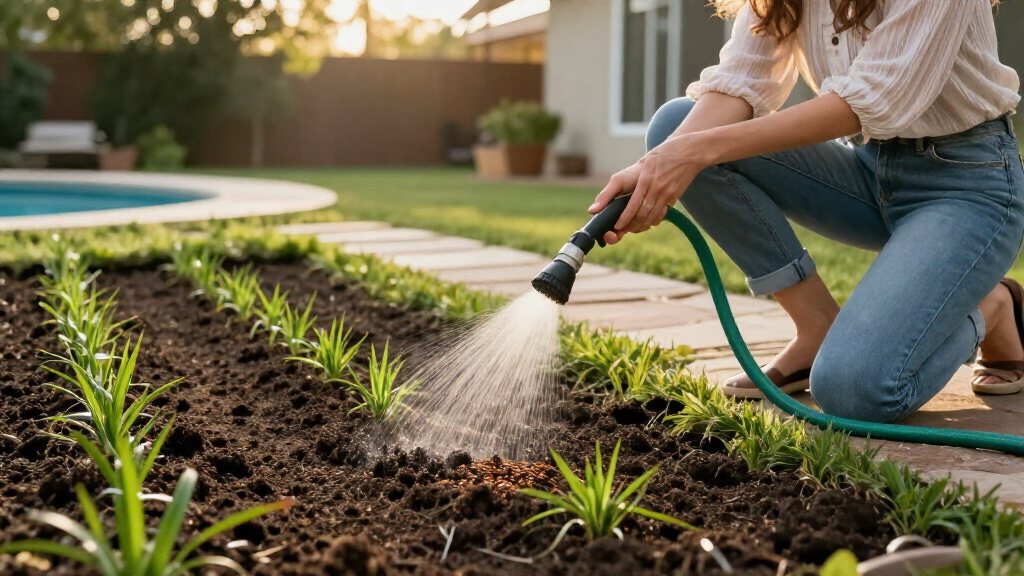
Watering should keep the upper inch of soil damp, not waterlogged. The report recommends short, light watering once or twice a day, with an additional cycle when conditions are breezy and the surface dries quickly. It also suggests spreading screened compost no more than ¼ inch thick to slow drying and offer some protection from heavy rain. Once seedlings have roots, the advice is to water less often but more deeply.
Why Patchy Fall Germination Happens
These steps matter because slow or uneven emergence can be normal, particularly when a lawn is seeded with a mix of varieties. Recognizing different germination schedules can help homeowners avoid assuming too early that a seed product is defective or that an entire area needs to be reseeded.
Preparation and watering also affect whether seed can germinate at all. Seed left on dry thatch may lose moisture, while seed that dries after it begins to swell may fail. Conversely, long or heavy watering can move seed into low spots or leave soil waterlogged. A thin cover and careful watering address those risks without burying the seed too deeply.
The report does not promise a particular emergence date or guarantee that these practices will speed every lawn. Conditions vary by seed type, soil and weather; the guidance describes steps intended to support germination, not a substitute for choosing an appropriate grass and sowing at a suitable time.
Products Worth Considering

Ring Floodlight Cam Wired Plus, 1080p HD Outdoor Security Camera with Motion-Activated Floodlights, 4-Pack, White

Dreame H15 Pro Wet-Dry Vacuum and Mop

Dyson V8 Cyclone Cordless Vacuum
As an affiliate, we earn on qualifying purchases.
Grass Type and Fall Timing
Fall is commonly used to seed cool-season lawns because soil may retain summer warmth while air temperatures cool and rainfall increases. The source says these seeds generally will not germinate until soil is above about 50°F; colder soil can delay germination, potentially until spring. It recommends checking soil temperature with a thermometer rather than judging conditions from air temperature alone.
The regional planting window varies. The report places the usual window in upper Midwest and other northern areas from mid-August to mid-September, generally closing by October. Farther south, including Tennessee, seeding may be possible into mid-October. Late sowing leaves less time for new grass to establish before a hard freeze. Warm-season grasses such as Bermuda, zoysia and bahiagrass are generally seeded later, after soil warms in late spring or early summer.
“Ryegrass can be up in about a week, while bluegrass may take a month.”
— Gardening Know How report
What Affects the Timeline
The supplied report does not give a universal number of days for a lawn to fill in, and actual germination time depends on conditions. The seed variety or mix, soil temperature, moisture, seed placement and local weather can all affect how quickly seedlings appear. It is also not clear from the source what conditions apply to any individual reader’s lawn.
Emergence is not the same as establishment. The report says new grass needs several more weeks to root in after it turns green. It provides no guaranteed results for the three practices and does not specify a single watering schedule that would suit every soil, climate or rainfall pattern.
Check the Seedbed Before Reseeding
For homeowners waiting on a newly seeded area, the report’s guidance points to checking the seed mix and observing the seedbed before deciding that nothing will grow. Look for seed sitting above the soil, a surface that dries between watering, or soil temperatures below the reported threshold. Where seed has only recently been sown, the slower schedule of Kentucky bluegrass may help explain why the ground still looks bare.
Any follow-up should account for the local planting window and forecast, especially as the first hard freeze approaches. If seedlings emerge, continue caring for them while they establish roots; if they do not, the source offers no fixed cutoff for declaring a seeding unsuccessful. The appropriate next step will depend on the grass type and local conditions.
Key Questions
How long does grass seed usually take to sprout?
It depends on the variety. The report gives a range of about five to 10 days for perennial ryegrass, one to two weeks for tall fescue, and at least two weeks—sometimes close to a month—for Kentucky bluegrass.
Does bare ground after two weeks mean the seed has failed?
Not necessarily. Some grass varieties take longer than two weeks, and a blend may emerge unevenly. Soil temperature, moisture and whether seed is in contact with soil can also affect timing.
How often should I water newly sown grass seed?
The report suggests short, light watering once or twice a day to keep the top inch of soil damp, adding a cycle when the surface dries quickly. Avoid keeping the seedbed muddy; adjust for local weather and soil conditions.
How thick should compost be over grass seed?
Use a light layer of screened compost, no more than about ¼ inch, according to the report. The seed and soil should still be visible through it.
Will these steps guarantee faster germination?
No. The report presents them as practices that may support germination, not as a guarantee. Grass type, soil temperature, weather, moisture and seed placement still affect how quickly seedlings appear.
Source: gardeningknowhow.com